About-France.com
- the connoisseur's guide to France
| Page index | Regional information |
| Main tourist attractions | Regional specialities |
A short guide to Franche-Comté
The
Franche Comté region is a beautiful rural area of
eastern France that has a lot to offer in terms of natural environment,
historic heritage, museums and sites. Lying between Burgundy and
Alsace, and between Champagne and Switzerland, it is possibly the most
underrated of all French regions, in terms of tourism and holiday
potential.
Franche-Comté can essentially be divided into two areas; the area to the north and northwest of the Doubs valley, and the area to the south and southeast. The northeasterrn part, essentially the department of the Haute Saone (70) is a deeply agricultural area, with small towns and villages, low hills and valleys, but rising into the foothills of the Vosges mountains to the east. The rest of the area, between the valley of the river Doubs and the Swiss border, covers the French Jura mountains, whose landsapes of hills, meadows and spruce forests have become the iconic images of this largely rural area.
In the centre of the region, between the Haute-Saône and the Swiss border is the department of the Doubs (25), consisting of a series of plateaux and hilly ridges rising from 200 metres in the north to 1200 metres on the Swiss border. In the south of the region, the department of the Jura (39) is divided into plain and mountain areas, as it covers part of the broad flat Saône valley, plus the central part of the Jura mountains, peaking at over 1500 metres on the Swiss border. Finally, in the north of the region lies the smallest of all French departments (except Paris), the territoire de Belfort, an area that was for centuries the French-speaking part of Alsace. This department is quite industrialised, and the area round Belfort and Montbéliard is the home of the Peugeot car group.

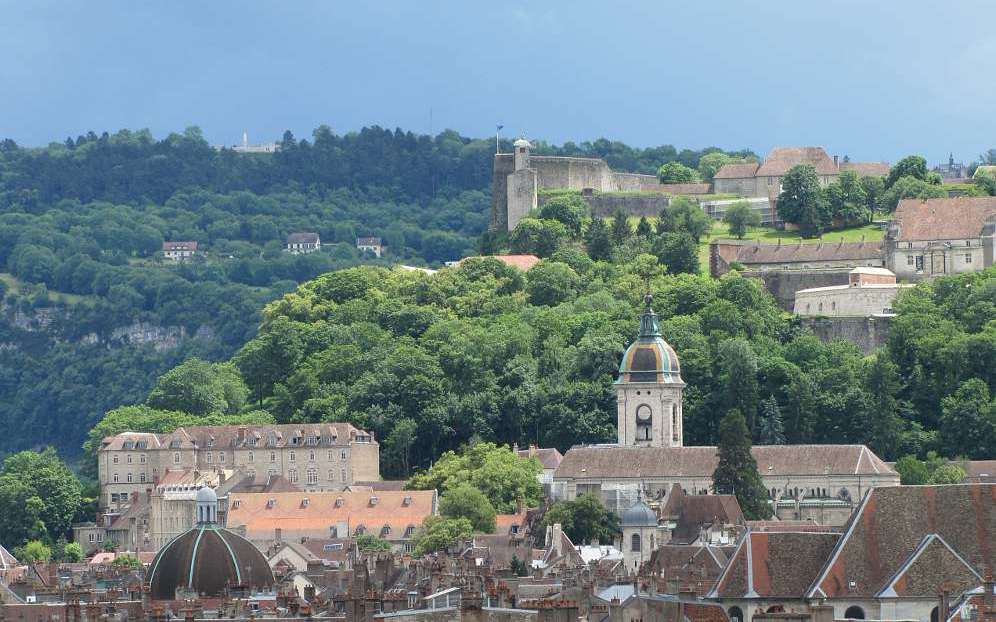
View across the rooftops of old Besançon, to the Cathedral and Vauban's citadel (UNESCO world heritage site)
Besides its Musée des Beaux Arts, the city has two other major museums, the Museum of time, housed in the 16th century Granvelle Palace, a jewel of the French renaissance, and the museum of the Resistance and the Deportation, one of a number of museums and sites in the Citadel, a stronghold fortified by the great military architect Vauban in the 17th century, and classed as a UNESCO world heritage site in 2008. There is also a fine cathedral, the birthplace of Victor Hugo, and river cruises.
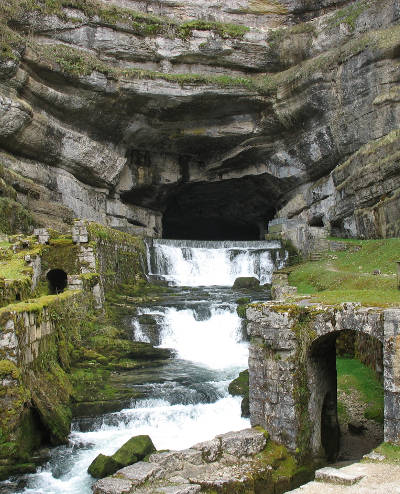
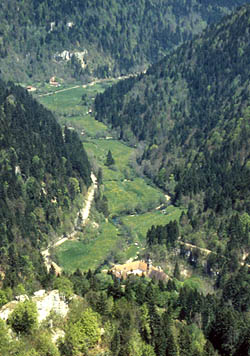
The source of the River Loue - which emerges, already a river, at the foot of a deep gorge
This is an area famous for its agricultural products, notably the famous "Comté" cheese, very similar to Swiss Gruyère, and smoked sausages. It is also famous as France's watchmaking area - watchmaking being an industry that is still active either side of the Swiss border. Franche Comté is also the home of France's optical glasses and spectacle industry, and the town of St Claude in the Jura is famous for its pipes. In the north of the region, the area around the towns of Montbéliard and Belfort is the heartland of the region's most famous company, Peugeot, which has a major production unit at Sochaux.
Regional specialities: Like many mountain regions, Franche-Comté boasts plenty of delicious regional specialities; among the most famous are its cheeses: of these, the most famous is Comté (pronounced contay) cheese, similar to the Swiss Gruyère cheese but with its own distinctive taste. This has recently become the most popular cheese in France, in spite of the fact that it remains produced in farms and rural dairies (known as fruitières) using an age-old traditional process. Other cheeses from this region are Mont d'Or - also called Vacherin - Morbier, Bleu de Gex (see About-France.com Cheeses page).
Apart from its cheeses, Franche-Comté is renowned for other gourmet delights, notably its charcuterie: Morteau sausage, a smoked mountain sausage that can be boiled or grilled; Montbéliard sausage - similar but smaller; mountain ham. As for wines, Franche-Comté has them too : Arbois and Côtes du Jura are the great regional AOC wines, and Arbois white is especially distinctive, when made from Savagnin grapes. The Jura also produces a very special aperitif wine, called Vin Jaune; the most famous vin jaune comes from Chateau Chalon, a village that is one of the most attractive in eastern France..
Access: The regional capital of Franche-Comté, Besançon, is accessible by direct TGV train from Paris (2h 30) or from Strasbourg, Lyon or Zurich. The region is crossed by motorway routes to southern France and Switzerland. The region has no airport, but three airports just outside Franche Comé are served by Easyjet from the UK, and flights from many other cities in Europe; Basel-Mulhouse Euroairport in the north, Geneva Cointrin in the south, and Lyon St. Exupéry in the south west.
Main tourist attractions in Franche Comté
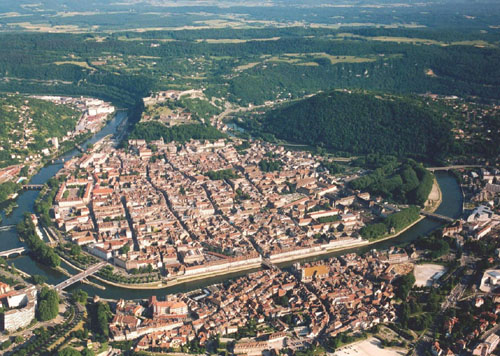
Besançon from the air - Photo JP Tupin - Ville de Besançon .
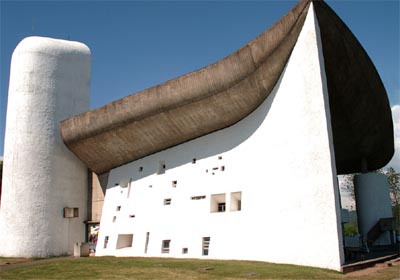 Le
Corbusier's chapel at Ronchamp
Le
Corbusier's chapel at Ronchamp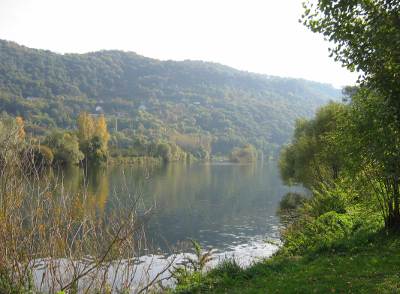
Valley of the river Doubs, near Besançon
- River cruising (boat hire) on the Saône, at Gray (70) and/or the Doubs at Dôle (39)
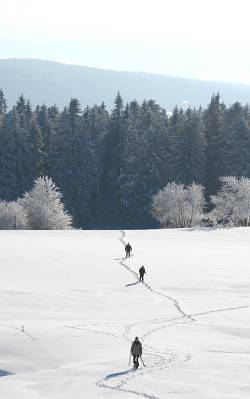
- Natural environment of the Haut Doubs (25) and Haut Jura (39); hills, forests, lakes. Haut Jura Regional Park around the ski resourt of Les Rousses.
- Besançon. Site, historic centre, Vauban's citadel (UNESCO world heritage site), Roman triumphal arch, Musée des Beaux Arts, Palais Granvelle, Musée du Temps, Musée de la Résistance, St. Jean's cathedral, riverboats.
- Ecomusée de Franche Comté - Open air museum of historic houses, Nancray, near Besançon.
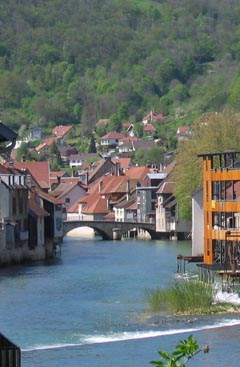
- Ornans : site in the Loue valley, birthplace of Gustave Courbet, Courbet museum.
- Loue valley from Ornans to Source de la Loue - deep gorge, with impressive crags.
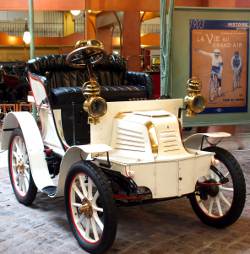
- Peugeot motor museum, Montbéliard : over 200 historic cars.
- Arc et Senans: Royal Saltworks, visionary 18th century development by Claude-Nicolas Ledoux; a UNESCO World Heritage Site.
- Saut du Doubs: near Villers le Lac, on the Swiss border. Impressive waterfall of the river Doubs, accessible by boat trip from Villers.
- Source de la Loue - where the river Loue emerges at the foot of a steep gorge.
- Natural environment of the Haut Doubs
- Metabief / Mont d'Or: Small ski resort with summer activities; Le Conifer steam railway. Lac de St Point; one of the larger lakes in France.
- Chateau de Joux Impressive fortress commanding a narrow valley near the Swiss border.
- Dôle - Small town on the Doubs - birthplace of Pasteur
- Arbois - Attractive small town in the heart of the Jura vineyard. Maison Pasteur, Pasteur's family home
- Château Chalon: very pretty village perched on a cliff overlooking the famous vineyards.
- Lons le Saunier : Attractive small town. The Laughing Cow cheese museum
- Lac de Chalain : popular lake in the Jura hills. Boating, swimming.
- Les Rousses - Lamoura : Haut Jura regional park, popular skiing area in winter, hiking and rambling area in summer.
Haute Saone (70) and Territoire de Belfort (90):
- Chapelle Notre Dame du Haut, masterpiece of swiss architect Le Corbusier. Ronchamp (70), near Lure.
- Luxeuil - Attractive old town near the Vosges mountains
- Ballon d'Alsace (90) ; the southern peak of the Vosges mountains - on the border of Franche-Comté, Alsace and Lorraine.
About-France.com
Home
- Site
search - Regions
- Maps of France