
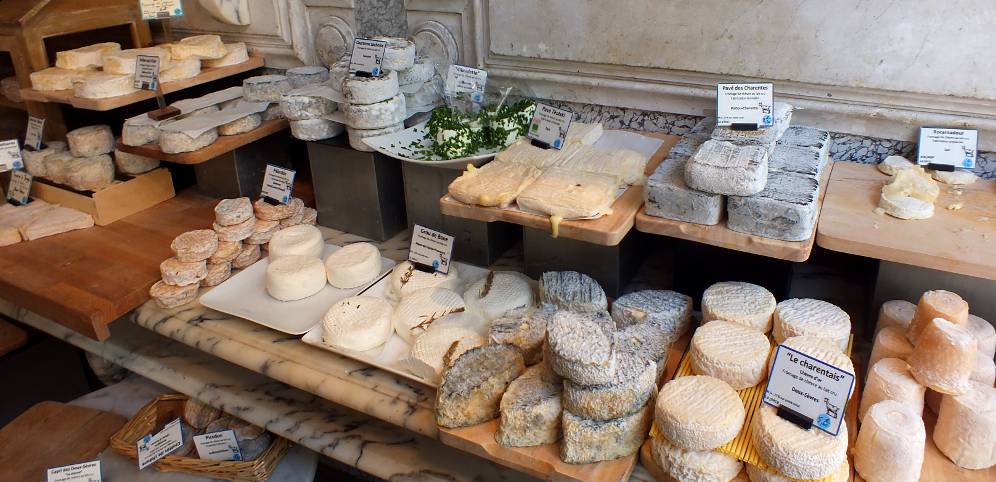
A guide to French cheese
Discover the different cheeses of France
- Explore France ►
- KEY PAGES
- Where to go
- How to get there
- More about France
About-France.com
- the connoisseur's guide to France
Discover
the cheeses of France.....
If
French cheese for you just means brie,
camembert, roquefort
and the "stuff that looks like cheddar or gouda" in the local
supermarché when you're on holiday, then you don't know what
you're
missing!
Every region of France has its own particular cheeses. Back in the time of General de Gaulle, France had 246 cheeses - and it has quite a few more than that now, given the large number of new products, inventions or copies of traditional cheeses, that have emerged from France's hundreds of dairy companies in the past 20 years. This guide is not by any means a comprehensive listing of all the products that France can offer to deck a well-garnished cheese-board. It is a look at some of the most common, and the most tasty.
Every region of France has its own particular cheeses. Back in the time of General de Gaulle, France had 246 cheeses - and it has quite a few more than that now, given the large number of new products, inventions or copies of traditional cheeses, that have emerged from France's hundreds of dairy companies in the past 20 years. This guide is not by any means a comprehensive listing of all the products that France can offer to deck a well-garnished cheese-board. It is a look at some of the most common, and the most tasty.
| Go to ► | Pressed cheeses | Soft cheeses |
| French blue cheeses | Cheese and wine |
The main types of French Cheese
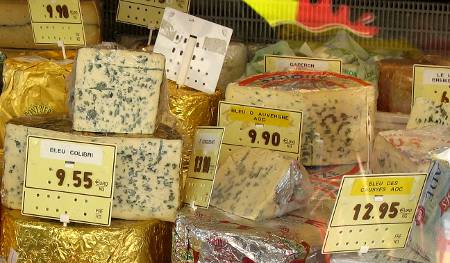
Choice of blue cheeses in a French cheese shop
French cheeses can be divided into three main families:
-
pressed
cheeses (like most
British cheeses)
- soft
cheeses , such as Camembert
- blue
cheeses to which can be added a number of hybrids or very
individual cheeses.Three different types of milk;
Cheese is traditionally made from three types of milk:
- cow's milk
- goat's milk
- sheep's milk (ewe's milk)
Two origins:
And they are further divided into cheeses from the farmhouse (fromages fermiers) , or industrially manufactured cheeses (fromages laitiers).
Labels:
A further distinction is also possible: traditional regional cheeses with an "appellation d'origine protégée" (AOP) label (there are about 40 of these), traditional cheeses without an AOP label, and modern dairy-designed and produced cheeses.
This brief guide looks at a good selection of French cheeses looking at each of these categories in turn.
The families of cheese:
1. Pressed cheeses. All of these are made from cow's milk
 |
Cantal
 A
very tasty uncooked pressed cheese from the Auvergne
mountains,
Cantal is a cheese that many consider to be quite close to an English
farmhouse cheddar or chester. A lot of this "AOP"
cheese is made on farms, but obviously local dairies in the region also
produce it in large quantities.
A
very tasty uncooked pressed cheese from the Auvergne
mountains,
Cantal is a cheese that many consider to be quite close to an English
farmhouse cheddar or chester. A lot of this "AOP"
cheese is made on farms, but obviously local dairies in the region also
produce it in large quantities.Cantal comes in two varieties: "jeune" (young) and "entre deux" (between two), meaning cheese that has matured for longer. This cheese's strength and taste increase with ageing, and generally speaking cantal cheese is stronger than cheddar.
Two smaller areas within or bordering the Cantal department produce specific appellations of their own, Salers and Laguiole. These cheeses - made from the milk of cows grazing at high altitude, tend to be more expensive than generic Cantal, and are generally aged longer.
Comté
This delicious French cousin of the swiss "Gruyère" cheese is an appellation protégée cheese from the Franche Comté region of eastern France. The production area stretches along the Swiss border, and all milk comes from cows grazing at at least 400 metres altitude. This cooked cheese is manufactured collectively village by village, and the production method has changed little over hundreds of years.
Though produced village by village, in the local village dairy (the "fruitière"), a lot of Comté is matured for up to two years in industrial cellars by large dairy companies such as Jurador.
Comté cheese generally comes without holes in it; but sometimes it may have small holes. Like Cantal, Comté comes in different varieties, sometimes called "fruité" or "salé" (fruity or salty). Fruité Comté is often more elastic; salé is usually a little more brittle. The most expensive Comté is "Comté vieux" (old Comté), which is generally aged over six months and possibly over a year. Comté is the traditional cheese used in a cheese "fondue", and also for "raclette" (see below).
Cheese that is produced using
milk not
coming from cows grazing according to the "appellation
contrôlée"
rules for Comté, can be used to make French Gruyère.
Although Gruyère is the name of a Swiss village, it has
recently been
given an IGP label
(= PGI - Protected Geographical Indication) in France.
Gruyère is an AOP
in Switzerland.
Cheeses similar to comté are Beaufort, and Abondance made in a similar manner in the French alps. Beaufort tends to be stronger tasting than Comté, and the taste is also slightly different.
(On the cheese map, the three large cheeses centre right are -top to bottom- Comté, Emmental and Beaufort).
Emmental
Emmental is your traditional cheese with holes in it. It is not an appellation contrôlée cheese, and is thus produced over a large area of France, notably in the east. It lacks the finesse of Comté, and is generally produced industrially, though industrial producers have their own label of quality for this cheese. French Emmental benefits from an IGP label.
Mimolette
A round cheese, made in the area of Lille in the north of France. It's orange colour is the result of the addition of natural coloring. The cheese was originally made as a French variation of the Dutch Edam cheese, to which it is very similar.
(Tomme des) Pyrénées
This slightly-cooked hard cheese is produced, obviously, in the Pyrenees - though it does not benefit from an appellation contrôlée label. Pyrenees comes with a distinctive black skin. Generally speaking it is a fairly bland cheese that will appeal to those who do not like strong-tasting cheeses. An IGP cheese.
Reblochon: A rich soft pressed cheese made in the Alps; it has quite a strong flavour, and a creamy texture.
2. Soft cheeses
There are literally hundreds of soft French cheeses; each region has its own specialities. Many of these - notably those with appellation contrôlée - are manufactured in small units, and (with notable exceptions such as Brie and St. Nectaire) if you want to buy one, you must buy a whole cheese.Brie
There are two sorts of Brie, Brie de Meaux and Brie de Melun, both appellation contrôlée (AOC) cheeses named after two nearby towns in the the country some fifty miles south east of Paris. Brie comes as a thin round cheese about 20 inches in diameter, with a soft white crust. This crust is eaten, not cut off! Brie is a very mild creamy cheese that should appeal to anyone who does not enjoy strong tasting cheese.
Camembert:
A cheese from Normandy, Camembert is perhaps the most famous French cheese, and is known and imitated worldwide. A ripe Camembert should be just soft on the inside, but not too runny. A young Camembert will tend to be hard and dry, and rather tasteless; an overripe Camembert, going yellowish on the outside, will tend to smell quite strongly and is not to be reccommended other than to those who enjoy strong cheeses. The crust of a Camembert is usually eaten.
Supermarkets are full of Camembert lookalikes, since any similar cheese that is not manufactured in the appellation contrôlée area in Normandy cannot call itself Camembert. These lookalikes tend to be sold young. To test a Camembert or a lookalike, open the box (not the protective wrapping paper!) and press gently. The cheese should be just soft, but not spongy.
Epoisses
A fairly strong "rind-washed" soft cheese from the Burgundy region. Thicker than a Camembert, Epoisses, like other rind washed cheeses, is yellowish on the outside, and white on the inside. The white centre is often almost crumbly, while the cheese under the skin remains very soft. Epoisses has a distinctive taste, shared with a similar cheese from a bit further north "Langres"; both of these cheeses are appellation contrôlée cheeses, and are admirable accompaniments for red wine. Another cheese in the same family is Maroilles, made in the north of France.
Gaperon
A semi-soft cheese from Auvergne, made with cows milk, and flavoured with pepper and garlic. A small hemispherical cheese weighing about half a pound.
Mont d'Or
This very distinctive appellation contrôlée cheese from Franche Comté, (known as Vacherin in Switzerland), is manufactured along the French-Swiss border, at altitudes of at least 800 metres. Like Comté that is made in the same region, it is a cheese whose manufacturing process has changed little over the centuries. This rind washed cheese matures in a round frame made of a thin strip of local spruce wood. In the course of maturing, this wood imparts a delicious aroma into the cheese which is later packaged and sold in round boxes made from the same wood.
Unfortunately, Mont d'Or is a seasonal cheese and is not manufactured in the summer months because the milk quality in the regin is different when the cows have rich summer pastures to graze on. However modern storage methods now mean that it remains available almost throughout the year in some outlets.
This cheese comes with an undulating beige crust, and under the crust the cheese itself is soft to runny. Though it is quite a strong cheese, Mont d'Or is not usually a sharp cheese. It tends to appeal to all tastes.
In recent years, local dairies have looked for ways to produce and market a cheese similar to Mont d'Or year-round. The most successful imitation is called Edel de Cleron, made in the Franche Comté region, but in a dairy at a lower altitude. Like Mont d'Or, Edel is packaged in spruce wood, to give it the distinctive aroma.
Munster
A fairly strong rind-washed soft cheese from the Vosges mountains in Eastern France, in the Lorraine region. Munster is definitely not a cheese for those who do not like strong tasting varieties. It comes in two varieties, normal and "au cumin" (with cumin seed). Darker on the outside than Langres or Epoisses, Munster generally has a thicker rind which some eat, others cut off. Even an unripe Munster is tasty; a ripe one - which may well be quite hard on the inside - will be very strong. However, like other strong cheeses, Munster should never have an acrid taste. If it does, it is over-ripe.
Pont l'Evèque
A creamy soft cheese, uncooked and unpressed, from the coastal region of Normandy, south of Deauville; this is one of the oldest cheeses in France, and has been documented since the 12th century.
Saint Nectaire
Some claim that this is the greatest of French cheeses - and possibly this could be true for an exceptionally good cheese; but Saint Nectaire - an appellation contrôlée cheese from the mountains of the Auvergne - is, alas, a cheese that varies considerably in quality and taste. To start with there are two distinct types, the farm variety and the dairy variety. The farm variety is generally better and more expensive, the dairy variety, usually found in supermarkets, is frequently sold too young. When this cheese is young, it is quite dry and hard; a properly matured Saint Nectaire should be soft and elastic, with a slight tendency to flow if left at room temperature. One does not eat the rind of a Saint Nectaire.
A cheese very similar to Saint Nectaire - notably to the variety found in supermarkets - is Savaron, a non-appellation cheese that is also produced in the Auvergne but generally by industrial dairies.
Blue cheeses
 Bleu
d'Auvergne
- An appellation contrôlée cheese whose quality
and taste can vary
considerably , going from the bland to the sharp. Even in a
supermarket, you can ask to taste before you buy. Specific varieties of
Bleu d'Auvergne include the ancient Bleu
de Laqueille .
Bleu
d'Auvergne
- An appellation contrôlée cheese whose quality
and taste can vary
considerably , going from the bland to the sharp. Even in a
supermarket, you can ask to taste before you buy. Specific varieties of
Bleu d'Auvergne include the ancient Bleu
de Laqueille . A popular modern variant of Bleu d'Auvergne is Saint Agur, a creamy blue cheese made in the Velay hills of Haute Loire by the large industrial dairy group Bongrain. There is no village called Saint Agur - indeed no saint either - but Saint Agur cheese is made according to traditional methods
Bleu de Bresse - Not an appellation contrôlée cheese, but a French industrial dairy's attempt to imitate the success of Danish blue. Soft and almost spreadable cheese.
Bleu des Causses - An appellation contrôlée cheese which is generally delicious and strong tasting, without being sharp. A cows-milk cheese, sometimes quite crumbly, manufactured in the same area as Roquefort and quite similar tasting.
Bleu de Gex - A blue from the swiss border, rather hard and not very strong.
Fourme d'Ambert - a mild blue cheese from the Auvergne, often with an almost nutty flavour. No-one should find this too strong.
Roquefort - The most famous French blue cheese, though not necessarily the best. Roquefort is an Appellation contrôlée cheese, made from the milk of one single breed of sheep, the "Lacaune" breed. The cheese has been made since the Middle Ages, and has been famous for many centuries; more recently it has been the object of intense and successful marketing. Over 18,000 tons of Roquefort are manufactured each year, and the cheese is exported worldwide. Made in the "causses" mountains of southern France, in the department of the Aveyron, and matured in caves. In the past, a lot of the milk used in the making of Roquefort is imported into the region; but the cheese's success has led to a development of sheep rearing in the Aveyron, and all the milk used in Roquefort is now sourced locally.
Other cheeses
Goat's cheeses:
Crottin de Chavignol, Valençay, etc... There are dozens of different goats' cheeses, and many local producers market their cheese under their own local village or regional name. Goats' cheeses can be sold either very young (frais), when they are soft and spreadable, medium matured, when they are still soft, but not spreadable, or fully matured, when they are hard.
Ewe's milk cheeses:
Ineguy : pressed cheese from the Basque country, similar to other southern European ewe's milk cheeses such as Pecorino.
Some modern dairy cheeeses
Saint Agur (a soft blue cheese, made in the Auvergne) ,
Brillat-Savarin (an almost buttery soft cheese... delicious, but watch the cholesterol...),
Roulade,
Saint Albray,
Port Salut,
Boursin (a cream cheese with herbs and garlic).
Raclette
Raclette is a mass-produced industrial cheese designed for a "raclette", i.e. a meal in which thin slices of cheese are heated and melted then poured over baked potatoes and eaten with gherkins, mountain ham and other accompaniments. Raclette is an easy and convivial meal, where everyone serves themselves from the raclette grill which is placed in the middle of the table. (Traditionally, the cheese was melted in front of a hot wood fire). However, "raclette" cheese is not the best cheese for a raclette. Prefer Comté (the best) or even Cantal.
Generic terms:
The words "tomme" and "fourme" are generic words that can describe several different types of French cheese. Etymologically, the French word for cheese, "fromage" is a diminutive of the word "fourme".
Unusual cheeses
Cancoillotte -this very distinctive comes from Franche Comté; it is a runny cheese strongly flavoured with garlic, and is very much an acquired taste. It can be eaten cold or hot.
Cheeses and wine.
For information on wines, check out our French wine guide.You'll read a lot of pompous advice about how such and such a cheese goes well with such and such a wine. When this is not merely a marketing gambit by regional tourist boards and local farmers associations, anxious to sell as much local produce as possible, it is often just sophisticated influencing. The truth of the matter is that cheese and wine go together, and as long as you follow a few basic guidelines, you can match a wide range of wines with any cheese.
There is one exception; sweet white wines do not go well with cheese - unless the cheese is being used in a sweet/sour combination.
Red wines go best with most cheeses, though with some very strong cheeses it is better to choose a light-bodied red wine. Dry white wines also go well with cheese, especially with tasty but mild cheeses. But in the end, it has to be a matter of individual choice. Your idea of what goes well together is just as good as the next person's - even if the next person claims to be an expert. Remember the adage: "Even if all the experts agree, they may still be wrong." It's your taste against theirs.
France:
a nation of cheeses
In one of his memorable witticisms, General de Gaulle once quipped "How can you govern a country that has 246 varieties of cheese?" What he meant by that was not quite clear - whether he was commenting on France or on French cheese; yet this remark has gone down in history among de Gaulle's most memorable quotations. What he probably meant was that France as a country is as diverse as its cheeses - or vice-versa. And just as France is physically the most varied country in Europe, so its cheeses reflect this wide and rich cultural diversity. About-France.com helps you to distinguish your Bries from your Pyrenees.
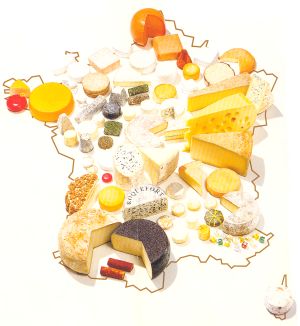
Map courtesy of Sopexa

 Can't get to France ?
Then let France come to you....
These are cheeses that can be bought from cheese merchants and supermarkets throughout France, and are also exported.

Accommodation in France
In one of his memorable witticisms, General de Gaulle once quipped "How can you govern a country that has 246 varieties of cheese?" What he meant by that was not quite clear - whether he was commenting on France or on French cheese; yet this remark has gone down in history among de Gaulle's most memorable quotations. What he probably meant was that France as a country is as diverse as its cheeses - or vice-versa. And just as France is physically the most varied country in Europe, so its cheeses reflect this wide and rich cultural diversity. About-France.com helps you to distinguish your Bries from your Pyrenees.
Map courtesy of Sopexa
Then let France come to you....
♥️ Check
out
some French
stores that deliver to your country
 French
cheese online in the UK
French
cheese online in the UK French
cheese online in the USA
French
cheese online in the USABest French cheeses
Here are ten great French cheeses, including the most popular cheeses with French consumers.These are cheeses that can be bought from cheese merchants and supermarkets throughout France, and are also exported.
- Camembert (a soft cheese from Normandy)
- Roquefort (A blue ewe's milk cheese from the Aveyron part of Occitanie)
- Comté (A pressed cheese from Franche Comté)
- Brie (A soft cheese from Ile de France)
- Bleu d'Auvergne (A blue cheese from Auvergne)
- Salers (A pressed cheese from Auvergne)
- Epoisses (A rind-washed soft but strong cheese from Burgundy)
- Munster (A rind-washed soft but strong cheese from Alsace - Lorraine)
- Saint Nectaire (A soft cheese from Auvergne)
- Buche de chèvre (Goat's cheese, produced in many regions)
►► More topics on French life
- Living in France
- Finding a job & working in France
- Food & eating in France
- French bread
- Moving to France
- Shopping in France
- Opening and closing
- Doctors and emergencies
- Primary and secondary schools
- Universities in France
- French school holiday calendars
- The wines of France
- French cheese
- French perfume
Accommodation in France
Holiday cottage accommodation
Bed and breakfast in France
Independent hotels in France
Rural campsites in France
Hotels in France
Bed and breakfast in France
Independent hotels in France
Rural campsites in France
Hotels in France