About-France.com
- the connoisseur's guide to France
- On other pages ►
- Visiting Paris
- Stay and get round in Paris
- France beyond Paris
- More useful pages
Discover Paris
| On this page | The story of Paris | Getting round in Paris | Sights, attractions, ideas |

- ►
Staying in Paris Check out the Paris Hotel Guide page.
► Selected hotels See our Paris Hotel map for a hand-picked selection of conveniently located hotels, from luxury and boutique hotels to economy hotels; or visit our selection of good value hotels in Paris, or our choice of (relatively) cheap hotels in the French capital. - ► What to see - See Paris tourist attractions
- ► Using public transport - see How to use public transport in Paris
- ► Interactive tourist map See What's where in Paris? Easily find the sites and sights of Paris, with a simple click.
- ► Planning your trip to Paris Check out the About-France.com "Week in Paris" page: a sample six-day programme that will help you get the most of your week in the French capital.
- ► Christmas in Paris - see Christmas shopping and markets
- ► Paris at Easter- visiting France and Paris in the spring
- ► Monet in Paris Where to see great works by Monet and the Impressionists

Paris passes : choose the right one for your needs
Confused ? Between the Go City inclusive pass or the Paris City Pass or Paris Museum pass or Paris Visite or other options or buying tickets à la carte ??Click to compare the different Paris passes
A very short history of Paris
PARIS ! City of lights, city of love, and one of the most visited cities in the world.

In Roman times, the city expanded beyond the islands in the Seine, and became known as Lutetia.
During the decline of the Roman Empire, northern France was overrun by a Germanic tribe called the Franks, whose new kingdom - part of the Holy Roman Empire - became known as West Francia, with its capital at Paris.
In the early Middle Ages, West Francia became France, and Paris grew in importance as a European city. By the 12th century, when Notre Dame cathedral was built on the largest of the islands in the Seine, Paris was the capital of one of the most

Notre Dame Cathedral - medieval masterpiece
Many of the great buildings of Paris, such as the Louvre and the Panthéon, date from the 17th and 18th centuries when royal power in France was at its peak. Yet the "shape" of modern Paris was largely determined in the mid 19th century, when a radical city-planner, Baron Haussmann, was given the job of opening up the old city with its narrow twisting streets. Haussmann designed a city criss-crossed by broad tree-lined boulevards, flanked by spacious apartment buildings – which is essentially the Paris we know today. The Eiffel Tower was added for the Universal Exhibition of 1889.
Though the city walls are long gone, central Paris is now known as "Paris intra-muros", or Paris within the walls, which is the area with almost all the main tourist attractions. Where there once stood city walls, there is now the "boulevard périphérique" or inner ring road, clearly visible on the map. Beyond that the modern city of Paris extends in all directions.
On this and other pages, discover the About-France.com visitor guide to Paris, providing you with all you need to know when planning a trip to this magnificent city.
Paris info and pages on About-France.com
- ► General tips on getting round Paris
- ► An introduction to public transport in Paris
- ► Main Paris museums and attractions and other sights
- ► Paris tourist attractions map - Interactive
- ► Paris visitor passes: Compare passes: price, content, pros & cons
- ►
The Eiffel Tower
- ► Where to stay in Paris - the options
- ► Visiting Paris in the spring Or for Christmas shopping
- ► What's where? The quarters of Paris
- ► Paris for free... Even the Louvre is free sometimes !
- ► Paris on a tight budget - make the Euros go further.
- ► A week in Paris - a sample schedule
- ► Paris airport guide
- ► Paris with young children
- ► Car hire in Paris
- ►Monet in Paris Where to see great works by Monet and the Impressionists
- ►
The About-France.com choice of good
value hotels in Paris
IMPORTANT:
Eiffel Tower :
None
of the Paris passes include a lift/elevator ride up the Eiffel Tower. (One
pass offers a second level Eiffel Tower ticket on
foot.... but a
second level ticket is only € 10.50 on foot, or
€16.70 by lift/elevator
on the official Eiffel
Tower site !) Access to the top of the tower must always
be purchased separately, or as part of certain specific
tours . It cannot be bought once you reach the second level.
Buy your Paris
City Pass or your The
Paris Pass
online, then buy Eiffel tower ticket
online from the official site. See Eiffel
Tower
information.
Public transport
GETTING AROUND IN PARIS
You can travel almost anywhere in Paris and the suburbs for FREE if you buy an inexpensive
travel pass.
For details see ►
How to use public
transport in Paris

If you plan to use public transport other than buses, you'll need to buy a travel card. For details see How to use public transport in Paris. As from mid 2026, you will however be able to jump on a bus and pay a single journey (cost €2.10) with your Visa or Mastercard.; but take care.... two people will need two cards.
For more ideas on keeping down your travel costs, visit the Budget Paris page.
Tourist transport :
In addition to hop-on hop-off tour buses (see tourist passes), there is a range of other travel options for tourists. Apart from taxis, other more picturesque options include pedicabs and rickshaws, tours by historic 2CV (the iconic little French car), Segway tours, bike tours and walking trips.There is also a city-wide bike share system known as "Velib". How to make use of this system is explained on the Budget Paris page.
Make the best use of Public transport in Paris 2026
 Paper tickets for journeys
on Paris public transport have been phased
out. All journeys require a card of some sort, or an app. The
simplest card is the Navigo
Easy card which can either be loaded on your phone,
or bought as physical plastic
card from any ticket counter or from
the purple-and-white ticket machines in any
Metro or RER station.
Paper tickets for journeys
on Paris public transport have been phased
out. All journeys require a card of some sort, or an app. The
simplest card is the Navigo
Easy card which can either be loaded on your phone,
or bought as physical plastic
card from any ticket counter or from
the purple-and-white ticket machines in any
Metro or RER station.However by mid 2026, all buses will be equiped with touch points allowing a single journey to be bought directly using Visa or Master card. Note that you cannot tap a card twice for two people on the same journey. Two people traveling together need two Navigo cards.
The Navigo easy card
The plastic
card itself costs 2€, and is very easy to use.
You just "load" tickets onto it (for instance a pack
of 10 metro tickets or a Paris Visite pass) at a machine, or at a sales
counter,
then tap it on card readers at the turnstiles. Navigo easy
cards are not personal, and do not carry your name or photo, meaning
that you can lend them to a friend. However, you must write your name
on the back if you load a Paris Visite card, which is personal .
When you have your Navigo Easy card (plastic or on your phone), load onto it either a Navigo Day Pass (€12.30 for all zones, excluding airports) , or one or more single tickets, cost 2.55 € each, or a pack of 10 single tickets for 25.50 €. There is no longer a volume discount on these. Single tickets have no date limit. Each ticket is valid for 2 hours travel, or until you pass through an exit barrier.
Note: A Navigo day pass does not include access to/from Charles de Gaulle or Orly airports by RER train. For such destinations, you must load an airport ticket (or else use metro 14 to get to Orly)
However if you are using the app on your phone, or buy a Navigo Découverte (Discovery) pass, you can also load a Navigo Weekly Pass (€32.40 valid for a calendar week, i.e. Mon to Sun, and including airports), which can be cheaper depending on your arrival date.
Two alternative cards to compare
Visitors staying more than just a couple of days may like to obtaine either a Navigo Découverte card (cheaper) or a Paris visite card (simpler to set up).| Card / features | Navigo Découverte (cheaper) | Paris Visite (easier to set up) |
| Card Cost | 5 € (a plastic card) | No cost if loaded onto an app, 2 € if a plastic card is also required |
| Requirements | Physical photo + name written on card | Just write your name and dates |
| Validity | Strictly Monday to Sunday | Any consecutive 1, 2, 3, or 5 days |
| Price (5 Days) | 32.40 € Weekly + card | 45.40 € for
2 days, 78 € for 5 days .... + cost of card if needed. |
| Airport Access | Included | Included |
Changing trains:
Just one important point to note: while you can change metros or change buses on a standard journey ticket, you can't change from a bus journey to a metro journey, or vice-versa when using a single journey ticket. Of course, if you have a pass, there is no problem.
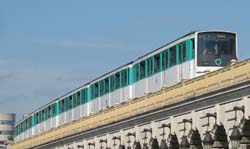
Though the Metro is mainly an underground system, several parts of the network are above ground, and offer an interesting way to see Paris from well above street level.
Finding your way in the metro.

This is no big problem. Using the maps available, check the line number and terminus station of each line you want to take. If you need to change routes, follow the "Correspondance" signs on the platform and through the foot tunnels; these indicate the line numbers and the termini. Just follow the right one. The RATP (Paris transport authority) provides free maps which are usually available in hotels, metro stations and other places.
Travelling outside Paris: use the trains or hire a car at a location on the outskirts of Paris, to avoid having to drive in the streets of Paris. See tips on car hire on the outskirts of Paris. Click here for travel to and from Paris airports
General Paris transport tips :
TIP - Train or bus from the airport: Generally speaking, the RER train service is fast, and cheapest. See Paris airport guide.TIP - Changing trains at "Chatelet" metro hub. Chatelet is the biggest interconnection station on the Paris metro system: three main RER (Regional Express Rail) routes cross here, notably B (for the airports) and A (serving the Gare de Lyon and Disneyland). If you are changing from a southbound "B" train to a south/east bound "A" train, (for instance, coming from Charles de Gaulle airport and heading for Gare de Lyon or Disneyland, a common combination), just cross the platform. The same goes if you are taking these routes in the opposite direction (for example coming from Gare de Lyon and heading for Charles de Gaulle airport). Nothing could be simpler!
For other changes, follow the indicator boards, having noted which RER or metro routes you want.
Taxis There are plenty of taxis available in Paris, though prices are high by world standards (less than Los Angeles, but more than San Francisco). There is also an Uber platform for Paris.
Buses and metros: With a pass, you can take buses and metros as much as you want. If using a single ticket, you can explore Paris for two hours on the metro.
Click here for Paris tourist attractions guide : Eiffel tower, Notre Dame, the Louvre, Montmartre, Moulin Rouge, and much more
About-France.com
Home
page - Site search
- Regions
- Maps of France
- Contact