
Academic
What's wrong with France ?
For more recent analysis of France's problems, see Can anyone change France? (April 2014)
Clearly not. Nor is it civil war in France. Yet interior minister Nicolas Sarkozy recently declared a state of emergency, and the government authorised curfews designed to get gangs of rioting youths off the streets at night in sensitive areas.
How has this come about, in a nation that likes to present itself to the world as a cradle of democracy and a paradigm of civilisation....?
Elites, Violence and the "French social model"
 How
is it that France, not long ago one of the economic leaders of postwar
Europe, has reached the state that it is in today? What is wrong in
modern France?
How
is it that France, not long ago one of the economic leaders of postwar
Europe, has reached the state that it is in today? What is wrong in
modern France?
Endemic
unemployment, stuck enduringly round the 10% mark, an
explosion of poverty in the suburbs and poor urban areas, falling
purchasing power for most French households, a serious brain drain
among its educated elites, particularly researchers and young managers,
strikes that have sometimes left cities like Marseilles
without public transport for up to a month, lorry drivers blockading
roads and petrol depots, a Corsica ferry hijacked by its sailors in the
framework of an industrial dispute, or nightly rioting in
poor suburbs sprawled around cities both large and small, across the
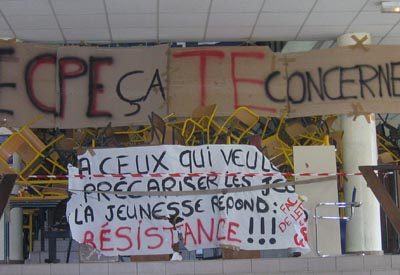
country, or students blockading universities in protest against new
employment laws.
All this in a country that is still a
great place to live, a country whose workforce has one of the highest
hourly rates of productivity in the whole of Europe, whose secondary
education system and health service – despite budgetary
problems - are
still the envy of many other countries, whose high-speed rail network
is the best in the world, whose motorway system is now one of the best
in Europe, whose high-tech and aerospace industries are world leaders,
where a university education is remarkably cheap and open to any
high-school graduate, whose top business schools are among the best in
the world, and where art and culture flourish.
In this postwar Europe, with two of the big member states still shouldering the massive burden of guilt for their recent pasts, unwilling to assert their positions, it fell to the third to embrace the role of natural leader of the new European community. France. And thus it was that the Common Market grew and developed in Cold War Europe as an emanation of French power and influence….. but also as a reflection of the French model of power, centralised, bureaucratic and to a large degree unanswerable.
Until recent years, there was a virtual national consensus in France regarding the value of French "models", social, political and economic, and to a large extent even today, intrinsic faith in them remains high. It was not until the final years of the twentieth century that there was any serious mainstream questioning of these models. Before then, the voices of criticism, some of them quite strident, came from edges of society, from the political fringes, but were classically disregarded or sidelined by the establishment. Not even the events of May 1968, the great flashpoint of France's postwar history, did anything to really change the situation. Apart from pulling France's youth rather belatedly into the "swinging sixties" and prompting some much needed reforms to higher education, May 68 really did little to change France. In spite of the revolutionary fever of the time, France in 1975 was not markedly different from France in 1965. The system, the Fifth Republic, survived intact.
Given the power and nature of the French establishment, this was hardly surprising.
Hidden by the strong rhetoric of democracy and equality that is the hallmark of political argument in France on both the left and the right, there lies the unpleasant reality that France is possibly the most elitist of all developed nations; and for anyone who considers that elitism rhymes with cronyism and is a far cry from equality, the fundamental flaw in the French model begins to become apparent. The system is built partly on the basis of a myth.
In most developed countries and indeed developing countries too, the nation's future elites – the future politicians, leaders of industry, senior civil servants – are educated along with the not-so-elites in universities, the pinnacle of most education systems. Not so in France, where the nation's elites are siphoned out of the system often before leaving their lyc�e, and cosseted through selective and highly elitist "grandes �coles" far from the rough and tumble of ordinary university life. If it doesn't start at home, the separation between France's elites and the rest of the population starts at high school, graduating from a "grande �cole" being a natural stepping stone towards many of the top jobs in France, particularly in the public sector. The old-boy (and to a lesser degree old-girl) networks of these schools run through the upper echelons of the French civil service, political parties of right and left, the armed forces, the media, culture and industry alike, an "elite" whose webs of influence make the concept of "the establishment" in English-speaking countries sound very informal.
Britons and Americans who get to know France, having been fed the image of France as the great champion of "liberty, equality and fraternity" are often more than surprised to discover France's preoccupation with its "great families", the post-revolutionary and post-imperial aristocracy of modern France, the barons of industry and their fortunes, many of them (like the Dassaults, the makers of Mirage jet fighters) with intimate family ties into the highest echelons of the state and politics.
Until the 1990's, most French people would probably have been surprised too. Beyond the circles of left-wing students, the Communist party and Le Canard Enchain� (the French equivalent of Private Eye), few people gave the question much thought. After all, since the elites controlled most of the media, political parties and much of the French establishment, and had no interest in sawing through the branch on which they were seated, questioning of the system per se was very limited.
Far from questioning the system, France's elites – notably through the control of the media and education – ensured that the "French model" and "French values" were perceived by ordinary Frenchmen and women as major sources of national pride, superior to those of other nations and in particular superior to the American and British models.
Given the nature of the education system in France, doing so was not difficult.
For generations, education in Britain and many other countries has involved teaching students not only to learn facts, but to question them too.
Not so in France. Secondary education here is largely a transmission of facts from teacher to student, including learning by rote. In terms of how much knowledge students actually acquire, the system is perhaps more efficient than the British system. But in terms of teaching them to think for themselves, to participate and to react, to develop the individual, the French system is certainly far less successful. This is deliberate; the lyc�e system in France was designed under Napoleon as a means of ensuring the education, by the state, of the educated classes who would ensure the functioning, development and perpetuation of the nation, the state and its institutions, including the army. In this it has been remarkably successful, just as it has been, until very recently, in ensuring respect by ordinary French men and women of French institutions and the French system in general.
Even though the French Revolution was a bloody event that led to a period in French history known as the "Terror", and subsequently to the replacement of the monarchy by an equally authoritarian Empire under Napoleon, "la R�volution" is remembered to this day as the greatest event in French history, as if it were still the defining moment for modern French society to this day. The expression "republican tradition" and the slogan "Liberty, Equality, Fraternity" have both been used ad nauseam by successions of French elites to instil into the French people the idea that those governing them were the direct successors of the original revolutionaries, and that somehow France and the French Model were unique democratic achievements in a hostile world.
These are France's great myths, and the problem is that to a large extent not just the French people in general, but also a large part of the French establishment, not to mention French intellectuals, came to believe them.
Serious problems in French society, when they existed, were pushed under the carpet. As early as the 1960's, voices were raised here and there against the social risks inherent in France's suburban development model of "grands ensembles", vast soulless apartment block developments on the outskirts of towns and cities, "les banlieues", concrete jungles for the new urban poor. A new word, "Sarcellite" (from the Paris suburb of Sarcelles) entered the French language, with the meaning of "suffering from the problems of suburban tower block development". Yet the policy of building huge tower block developments, often with minimal amenities tagged on as an afterthought, continued well into the 1980's. Today, a lot of these areas are ghettoes to ethnic minority communities… though one must not call them "communities" in France, because "community" is a dirty word, as if strong communities were a threat to national unity.
Problems in "les banlieues" have been part of French life for the best part of 30 years, but successive governments have largely turned a blind eye to them. To publicly recognise the extent of the failure of both French suburban development schemes, and French integration policies, would have been to publicly admit that the French way of life, the French social model, and indeed France itself were not actually all that they were made out to be, and not necessarily superior to the American model or the British model. And that would have been a fatal assault on the great French myths.
Even today, the extent to which people in France believe that their country is more democratic, more just, more socially tolerant and more welcoming than others, is quite surprising, even among educated and informed people. That is what they have been told. And until the mid nineties, it was a myth that very few people of any influence in France were interested in shooting down; it is almost as if there was an unwritten consensus between the left and the right, both politicians and intellectuals, that rocking this particular boat was of no advantage to anyone, and least of all to the elites themselves.
It is hardly surprising, under such circumstances, that France in the 1990's reacquired a reputation that it has carried at various points in history, that of an "arrogant nation". Arrogance comes naturally, when a nation and its elites fool themselves into believing that they and their system are somehow superior and hold the moral high ground compared to other nations. No one should have been surprised, given the self-imposed myth of the superiority of the French model, when the French hectored the Austrians on electing Haider, the Italians for electing Berlusconi, and Tony Blair for challenging that great French EU emanation, the Common Agricultural Policy.
Yet paradoxically, it is within France that the curses of elitism and arrogance have done their greatest damage, for it is these qualities that lie at the root of France's current ills. Clearly, governments and administrations and an intellectual establishment that arrogantly fool themselves and their people into thinking that their "models" are best do little to adapt these models to changing circumstances. In the age of the nation state, each nation had its own model, and different models worked in different countries. That age has passed, but France's elites have refused to recognise the change, carrying blithely on as if the French model would see off all potential problems.
It has not. While it has succeeded marvellously in maintaining in France a massive army of civil servants and public sector workers, a vast self-perpetuating bureaucracy of some 5 million employees (no one knows exactly how many), it has failed to ensure the economic vitality of France in a competitive international environment, and largely failed to integrate a second generation of immigrant origin. With unemployment running at over 20% among 18-24 year olds in general, and 40% of the active population in many of the low-income suburbs, home to most of France's ethnic minorities, the recent explosion of violence was, with hindsight, a disaster just waiting to happen, the consequence of over thirty years of failure to question, failure to heed the warnings, and tinkering on the edges instead of addressing the issues.
Yet all is not bleak. Until the mid nineties, questioning the fundamental validity of the French model of society was tantamount to social blasphemy. Those who did so were branded as irrelevant, extremists or misguided; or, perhaps the greatest of insults, they were accused of wanting to impose "anglo saxon" models and rampant economic liberalism in place of the social justice of the French model. In recent years, things have begun to change. The nation's leading newsmagazines and papers have increasingly highlighted the need for fundamental reform in France, and the enormous difficulty that France has in achieving such reform. Books such as "L'Arrogance Fran�aise", by Emmenuel Saint-Martin and Romain Gubert, a 2003 best seller, have set in train a wave of questioning. The 2005 rejection in a popular referendum of the European Constitution by French voters was seen in France less as a rejection of the European ideal, as defined by the Constitution's author former French president Val�ry Giscard d'Estaing, than as a serious vote of no confidence in the way France itself is being run.
Though many in positions of influence or authority initially claimed that the outbursts of violence in French suburbs were fomented by riff-raff and drug-dealers, which doubtless bore an element of truth, the root causes of the problem, massive unemployment and failed social integration, have also been recognised. Whether or not France is capable in the short term of enacting the measures necessary in order to eliminate the causes is open to doubt.
In the long term, things will change. At last, the consensus in France is coming round to acceptance of the view that all is not well, the French models are not as good as they have so long been made out to be, and that fundamental changes are essential. And they are coming.
For decades, proposals to make fundamental changes to the way things are done in France have floundered on the sandbanks of resistance from vested interests, be they lorry drivers protesting against increased fuel costs or teachers and students protesting against changes to the education system. The entropy of the French system seemed overpowering. Yet in 2003, the government did manage to push through a highly unpopular reform of the state pensions system, raising the retirement age for many categories of workers and reducing the opportunities for early retirement. Though hundreds of thousands of employees, particularly in the state sector, took to the streets in protest, the reform went through.
Many other reforms, fundamental changes to the "French system", are still required; and slowly but surely, at last, thing are starting to move in the right direction. Talk of wall-to-wall overhaul of French labour law, the famous "Code du Travail" an arcane and highly complex system of rules, restrictions and exemptions, is no longer a taboo subject... though still very sensitive with unions and young people. Fiscal reforms designed to encourage initiative and investment and reduce France's heavy tax burden, are also underway, albeit in a fairly piecemeal manner. And most important of all, the rock solid belief in the superiority of the French model has been seriously dented.
The rioting in French suburbs in Autumn 2005 may have been a ghastly moment of alarm for France; but it will also have been yet another wake-up call. Finding a new social model for France is now beginning to be seen as a national priority that will preoccupy the nation's decision makers for the foreseeable future. France's delusions of grandeur have been shattered. From now on, there can be no masking the need for change. Not even among the nation's elites.
Postscript: France in 2010
Since this article was written, France has continued to lurch forward. What has changed is that the nation's elites now realise the need for radical change, but after decades of vaunting the merits of the "French exception", France's elites find it extremely hard to make the French people accept these needs. The task is made all the harder in a country where a strong left wing element and a strong right-wing element always take any opportunity they can to contest virtually any changes proposed by any government that is not of their own persuasion. As a consequence, moderate political movements in France regularly find themselves obliged to pay lip service to more extreme groupings on their own side of the political spectrum, to avoid being accused of weakness. It's true on the left, and it's true on the right.
The 2010 protests against pension reform have developed in spite of the fact that all the main political parties accept that this is inevitable. But the Socialists, not wishing to lose voters to smaller parties to their left, have been forced into joining anti-government demonstrations and fanning the flames. To have not done so would have left them open to the accusation that they were no longer ready to stand up and defend France's welfare system; and that would have been a massive vote-loser for them, just a year and a half before elections. Still bitterly stung by their unexpected defeat in 2007, the Socialist Party will do anything it can to avoid a new defeat in 2012. If that means fanning the flames of protest for a few weeks, so be it. It's the French way.
Other countries look on in wonderment as high-school kids take to the streets to protest about pensions, and petrol pumps run dry. But that's the way France moves forward. It's slow, it's painful, and it's hard for people outside France to understand. But in a country where revolution is seen as an exercise of democratic rights, protesters usually draw public sympathy, and temporary chaos is seen as part of the price to pay.
�
2005 About-France.com -
Copyright
waiver: this text may be freely reproduced for educational
or non-commercial purposes, accompanied by the above copyright notice,
and, on websites, a hyperlink to https://about-france.com