About-France.com
- the connoisseur's guide to France
- Explore France ►
- Visiting Paris
- Stay and get round in Paris
- France beyond Paris
- More useful pages
Key facts & figures about France
Key facts and statistical data for France, with selected international comparisons
| On this page ► | Government | Geography |
| Economy | Local government | Population |
A definition
of France:
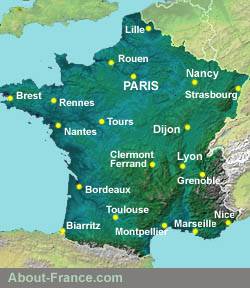
Technically speaking, "France" includes a number of overseas departments and territories (known in French as the DOM-TOMs), including Tahiti in the Pacific and French Guyana in South America. This guide however is concerned with Metropolitan France, which means continental France, together with the offshore islands, including Corsica.
Technically speaking, "France" includes a number of overseas departments and territories (known in French as the DOM-TOMs), including Tahiti in the Pacific and French Guyana in South America. This guide however is concerned with Metropolitan France, which means continental France, together with the offshore islands, including Corsica.
The Government of France:
France is a republic; the head of the executive is the President, elected by universal suffrage, currently Emmanuel Macron. The President determines policy with the aid of his Council of Ministers (Conseil des ministres). Ministers cannot sit in parliament, and if an elected member of parliament (député) is appointed minister, he or she has to hand over parliamentary duties to his / her deputy (adjoint). Since each elected member has a deputy, by-elections are unusual in France.Parliament:
The lower and principal house of parliament is the Assemblée nationale, or national assembly; the second chamber is the Sénat or Senate. Députés (members of parliament) are elected to the National Assembly by universal suffrage, in general elections (élections législatives) that take place every five years. Senators are chosen by an electoral college of "grand electors", who are mostly other local representatives.The electoral system for presidential and parliamentary elections involves two rounds; a candidate can be elected on the first round by obtaining an absolute majority of votes cast. The second round is a runoff between the leading two candidates from round one (presidential election), or two or more candidates (parliamentary elections).
Click here for further facts and information about the French Constitution and political system
Structure of local government:
Metropolitan France is administered as 13 regions (reduced from 22 as from 2016) , 96 "départements" or departments, and some 36,000 "communes". See maps of regions and departments.(There are also 4 overseas regions - French Guyana, Guadeloupe, Martinique, and Ile de la Réunion - and other overseas territories known as "TOM" )
Each region is administered by a Regional council (Conseil régional), and each department is administered by a county council (Conseil départemental - formerly Conseil Général). The central government is represented in each department and region by a Prefect (préfet), with powers over the police and public security. The Prefect's other main role is to make sure that local authorities administer their area in compliance with national law.
Prefects are appointed by the President, regional councils are elected by universal suffrage every six years, involving a complex two-round semi-proportional voting system.
Departmental councils, conseils départementaux, are elected by universal suffrage every six years, in elections known as canton elections (élections cantonales).
Communes are run by municipal councils (conseils municipaux) elected every six years by universal suffrage. Increasingly, the important business of small communes, and issues that involve communes and their neighbours are dealt with by groupings of communes, known as "Communauté de communes"
The Geography of metropolitan France (France in Europe): key data.
Surface area: 547,030 sq km, of which 545,630 sq km of land and 1,400 sq km of rivers and lakes.France compared to the UK:
France's surface area is about double the surface area of the United
Kingdom, and just over four times the surface area of England.
For more geographic details see the About-France.com Maps of France page and links
Basic
geographic facts:For more geographic details see the About-France.com Maps of France page and links
- Length of land border; 2889 km. Neighbouring countries: Belgium, Luxembourg, Germany, Switzerland, Italy, Monaco, Spain, Andorra.
- Length of coastline: 4,668 km
- Highest elevation: the peak of Mont Blanc, 4,807 metres or 15,782 ft.
- Arable farmland: 33.5% of the total surface area.
Demographics / Population information and statistics
- Population: 65.6 million total estimated population of Metropolitan France, in January 2022.
- This is about the same as the population of the United Kingdom.
- Population growth rate: 0.3% (2021)
- Birth rate: 12.49 births per 1000 (2014 estimate)
- Gender ratio: Average ratio 0.93 males per female (though 1.05 males per female in the under 15 age group).
- Life
expectancy at birth: Average: 82.4 years (males: 79.3
years, females: 85.4 years – 2021) -
Compare with: UK 71.1, Germany 80.9, Netherlands 81.4, Switzerland 82.9, USA 78.7, Belgium 80.7 (Source Eurostat and OECD) - Population
density: 110 people per sq km
This is just less than the EU average of 112 /km², and less than half the density of the UK (246 p/km²)
Economic facts and key statistical data
(See The French economy for an overview)Per capita GDP : 2024 : France : 42,590 € (Source: European commission)
Compare
with :
UK 45,529 €, Ireland 99,060 €, Belgium 51,810 €, Germany 50,830 €, Spain 32,590 €, Portugal 26,700 €.
Source: Statista.
UK 45,529 €, Ireland 99,060 €, Belgium 51,810 €, Germany 50,830 €, Spain 32,590 €, Portugal 26,700 €.
Source: Statista.
GDP by sector: agriculture: 2.2% industry:21% services: 76.7% (2007)
Economic growth 2018 : France: 1.5%
Compare
with :
UK 1.4%, Ireland 6.7% , Belgium 1.4%, Germany 1.4% , Spain 2.6%, Portugal 2.1 % .
Source: Eurostat 2019.
UK 1.4%, Ireland 6.7% , Belgium 1.4%, Germany 1.4% , Spain 2.6%, Portugal 2.1 % .
Source: Eurostat 2019.
Inflation Dec. 2025 : France 0.7% %
Compare
with :
Ireland +2.7% , Belgium +2.2%, UK +3%, Germany +2.0 % , Spain + 3 %, Portugal +2.4 %. European union average: +2.3%
Source: Eurostat
Ireland +2.7% , Belgium +2.2%, UK +3%, Germany +2.0 % , Spain + 3 %, Portugal +2.4 %. European union average: +2.3%
Source: Eurostat
Unemployment: Jan 2019 : France: 8.8%
Compare
with :
Ireland 5.3% , Belgium 5.6%, UK 4.0%, Germany 1.9 % , Spain 2.3 %, Portugal 6.7 % . European union average: 7.8 %
Source: Eurostat.
Ireland 5.3% , Belgium 5.6%, UK 4.0%, Germany 1.9 % , Spain 2.3 %, Portugal 6.7 % . European union average: 7.8 %
Source: Eurostat.
Employment by sector: 2011
France: Agriculture: 2.9%, industry: 22.1%, services: 75%
Compare
with :
U.K.: Agriculture: 1.2%, industry: 19.1%, services: 79.7% .
Germany: Agriculture: 1.6%, industry: 28.3%, services: 70.1% .
Spain: Agriculture: 4.2%, industry: 21.8%, services: 74% .
Czech republic: Agriculture: 32%, industry: 38.4%, services: 58.6% .
Source: Eurostat.
U.K.: Agriculture: 1.2%, industry: 19.1%, services: 79.7% .
Germany: Agriculture: 1.6%, industry: 28.3%, services: 70.1% .
Spain: Agriculture: 4.2%, industry: 21.8%, services: 74% .
Czech republic: Agriculture: 32%, industry: 38.4%, services: 58.6% .
Source: Eurostat.
► More facts, figures, information and statistical data about France
Visit the website of the French national statistical office INSEE or Eurostat
To
contact About-France.com, use the form
provided.
Sorry, we cannot respond to questions about individual travel plans.
Sorry, we cannot respond to questions about individual travel plans.
Copyright notice: Website and text copyright About-France.com except where otherwise indicated.
About-France.com
Home
page - Site search
- Regions
- Maps of France
- Contact