|
DRIVING IN OR THROUGH FRANCE - Info and tips for travellers
It is generally accepted that today's France has an excellent road
network; compared to the UK, France has the same population spread over
twice as much surface area, which tends to mean less congestion on the
roads, but longer distances to cover
Avoiding
problems In spite of the cost, it is
generally worthwhile taking
motorways (autoroutes)
unless you have time to go at a more leisurely pace. However,
there are some
useful tips to help you cut
down on the cost of
your trip across France.
a)
Petrol
(gasolene) (fr. essence):
don't fill up on the motorway! Wait until a major intersection near a
town or city, and come off the motorway. You will almost certainly find
a hypermarket / superstore within a kilometer or so of the exit,
offering cut price petrol. The saving can be us much as 20%.
b) If
you plan to do lots of holiday travelling in
France,
buy a diesel car
(but please, one with
the latest clean-burn engines with particle-filtering exhaust emission
control systems). Diesel fuel in France is about a third cheaper than
unleaded.... and it goes further.
c) Note
that there are some free
motorways in France,
and some long-distance dual carriageways that are up to motorway
standard.
Among free motorways note in particular
- about half of the
section between
Calais and Rouen
- the A75 motorway
between Clermont
Ferrand and
Beziers - an alternate route to the Spanish border. Careful however,
there is a bit (about 10%) of this still missing.
-
the motorway between Dunkerque and Lille.Main Roads
French
motorways
French motorways, known as
autoroutes, are
designated with numbers preceded by the letter A
(for Autoroute). Thus, you can leave Calais for the south either taking
the A16 towards Amiens and Paris, or the A26 towards Rheims and Paris.
Most French motorways are toll motorways. The cost of motorway travel
for a car without caravan or trailer is about 1 €uro for 10
miles.
For example, in January 2006, motorway tolls on the 1060 km trip from
Calais
to Marseille, via Paris, almost all of it on toll motorways, amounted
to 65
€uros, about £40.Follow
this link to the French motorway network website in English:
http://www.autoroutes.fr/voyage/itineraires.php?lng=2
This site provides a form to fill in, to calculate the cost of a
motorway
trip through France.
Trunk
roads in France are still popularly known as
"routes nationales".
However, in the framework of "regionalisation",
responsibility for main roads has been devolved to regions, and the
whole concept of "routes nationales" has officially disappeared.
The result is a classic state of confusion; instead of following, for
instance, the "N9" from Moulins to Béziers, drivers wishing
to use the "nationale" rather than the motorway would now follow green
trunk road signs, but a route whose number changes a bewildering number
of times; there will be a 9 in it somewhere, but that is about all; it
can be the D1009, the D409, and in places is still familiarly indicated
as the "N9".
This is all very confusing for foreign drivers, but not so
much for the French, since france has neverused numbering with great
significance,
and it is best to follow a destination,
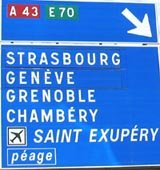
rather than a road number. Destinations via main trunk routes are
indicated by the names of towns in white letters on a bright green
background, as in

Sometimes you may see direction signs starting with the word Bis,
in italics. These are the equivalent of the British "HR" (holiday
route) itineraries, using less crowded main roads. Thus a sign saying
"bis
Lyon" is an alternative route avoiding the main roads, and generally
with less lorry traffic. Bis, in French, means second (as in the prefix
bi-)."Bison
Futé"
The
"Bison futé" (in English the cunning bison) is the one that
does
not follow the crowd, but seeks out less crowded easier routes, the
"routes bis", thus the "bis-on". If you
see a bison futé sign, it will be directing you either to
information about alternative routes, or to the alternative routes
themselves. On summer Saturdays, being a cunning bison is often well
worth it, unless you love sitting in bottlenecks.
Avoiding
Paris
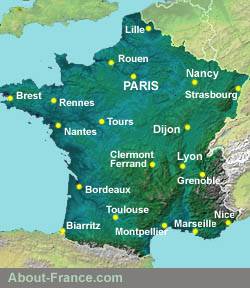
This is a good idea on most days. To travel from Calais to the south
coast,
use the A26 motorway via Reims, Troyes and Dijon.
For south western and central France, avoid Paris by taking the route
via
Rouen, Evreux, Chartres and Orleans. There is no motorway between
Evreux
and Orleans, but the route over this section is currently being
upgraded
to dual carriageway, and over half of it is now complete.
Avoiding
peak periods
If you
can avoid travelling on Saturdays
between July 10th and August 30th, this
is very advisable. On these days, many French motorways - and in
particular all
the routes to the south - are liable to reach saturation. The worst
bottlenecks
are in the Rhone valley south of Lyons, along the south
coast, and around Bordeaux.
In January and February, Alpine
motorways can get
hyper-snarled up with traffic.
However, outside these periods, Saturday
and Sunday are the
best days for travelling
in France, on motorways or "routes nationales" (trunk roads). Indeed,
on
these days, HGV's - lorries or trucks - are banned, meaning that unless
you
get stuck behind caravans or camper vans, combine harvesters or other
various
slowdowns, driving is relatively hassle-free.
Petrol
stations
Almost all stations accept Visa and Mastercard; however take care with
24h automatic pumps in supermarket forecourts. Many of these do not
accept credit cards without integrated chip and PIN number. If in
doubt, make sure that you
don't have to fill up
in an emergency at an unmanned filling station at night or on Sundays.
Speed
limits
Speed on most French motorways is limited to 130 km/hr (just over 80
mph). On dual carriageways, the limit is 110 km/hr, and on ordinary
roads it is 90 km/hr.
Generally, there is a small tolerance over and
above this
- but be advised that it is best to observe speed limits which are
there for a reason. Until recently, radar traps tended to be stationary
and visible; nowadays, the motorway police are using more and more
mobile radars, in unmarked
cars. Be warned ! Otherwise you may face an on-the-spot fine or - if
your
are more than 50 km/hr over the limit - an instant ban and an
impoundment
of your vehicle.Speed
cameras
Since 2004, France has discovered the speed camera, or fixed radar
camera. Over a
thousand of these have now gone up on France's roads and motorways, and
you can find the official
French radar map
of them on Internet. However, do not forget that new radars are being
set up all the time, and that the official map obviously does
not
include the mobile radar cars or the movable stationary radars. So the
best rule - not to say the most sensible one - is to observe the speed
limit.Wining and
driving
Wine is available with meals in French motorway service areas - a fact
that surprises a lot of visitors. But don't forget that the drink drive
limit
in France is lower than it is in the UK. The best advice is the same
everywhere;
don't drink and drive.
What
to do in the event of an accident in France
If you are involved in any accident involving two or more vehicles, you
will be asked to fill in a "constat amiable" (an amiable declaration)
by
the driver of a French car involved. This is standard
practice.
If possible, call your insurance company at once
on your mobile phone. They may put you in touch with a local French
representative.
If you are involved in an accident involving any
sort of
injury - even if it is not your fault - you MUST remain until
the
police have come.
Public
holidays in France.
The
following days are public holidays ("jours
fériés") in France, when all or most shops tend
to be shut.
January 1st, Easter Monday (though not
Good Friday except in Alsace),
May 1st, May 8th, Ascension Thursday (May 25th 2006) July
14th, August 15th, November 1st,
November 11th, Christmas. Unlike in the UK, when a
public
holiday falls during a weekend, there is no extra compensating holiday
on the following Monday.
Note that on public holidays,
hypermarkets will generally be shut, so unless you have a chip and pin
credit card that works in French automatic petrol pumps, you'll need to
fill up on the motorway or in normal filling stations.
Feature....
THE
BRIDGE OVER THE CLOUDS.......
The new
way to the
Spanish coast and the Languedoc.
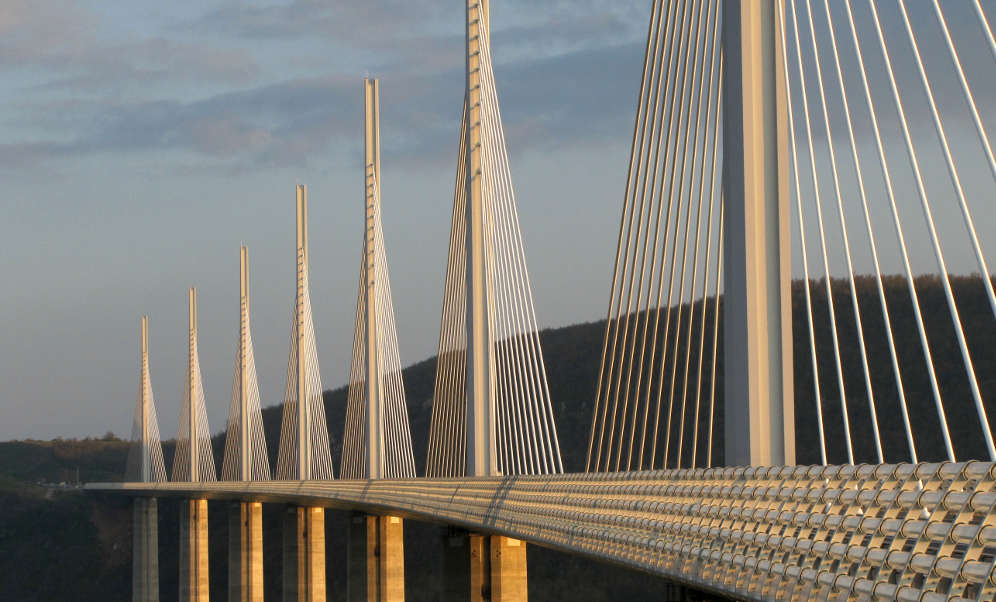
In December 2004, Norman
Foster's magnificent motorway bridge over
the Tarn valley at Millau opened to traffic. This is the world's
highest bridge (the deck is 900 ft above the valley floor at its
deepest) and the longest suspended bridge in the world, and an
engineering wonder of the world, worth the detour.
But if you are travelling to
the Spanish coast, it is not even a detour.
The A71 / A75 motorway route via Orleans and Clermont Ferrand is the
shortest and cheapest way to the Spanish border at Le Pertuis.
Furthermore, it is cheaper on tolls, as the section between Clermont
Ferrand and Beziers is free, except for the toll at the bridge, which
costs just over 5 Euros in winter, and a euro more in summer. The
motorway across the top of France's Massif Central remains at an
altitude of up to 1000 metres for about 100 miles, and is very
pretty;
but be warned. This is not
a route for cars towing laden caravans, as
there are several long and (for a motorway) steep climbs and descents.
It also has some speed
restrictions and permanent speed cameras
| To
contact About France com, send an email to info
"at" about-france.com (Replace "at" by the
standard symbol, and remove all spaces. This coding is a simple
anti-spam measure) |
|
|