
- ► Essential France
- ► Practical visitor info
- ► Where to go
- ► What to see and do

An
A-Z
Dictionary of France
C
C

| A | B | C | D | E | F | G | H | I |
| J | K | L | M | N | O | P | Q | |
| R | S | T | U | V | W | X | Y | Z |
Photo top of page : Champagne, the world's most recognised wine.
CAC 40. The best known of the French stock market indices, the "CAC" (an acronym ) is the index used to track the performance of the 40 largest capitalisations on the French stock exchange (la Bourse). In this respect, it is the French equivalent of the FTSE 100 in the UK, or the Dow Jones index in the USA. See also SBF 250.
Cadre : a manager or executive, notably in private sector employment. Though there is no formal definition of what a cadre is, the expression is regularly used in the language of business and industrial relations, and having the status of cadre within an enterprise usually brings privileges and specific terms of employment. Cadres supérieurs are the French equivalent of senior management. The status of cadre - albeit undefined - is extended by the French statistical office INSEE to top intellectual professions.
Cadre noir, le: See under Saumur.
CAF
: 1) Caisse
des Allocations Familiales
: the offices of the French Social Security system responsible for
paying family allowances, children's allowances, housing
benefit
and certain other allowances to eligible beneficiaries, except for
state employees who receive these allowances directly with their pay.
2) See Club
Alpin Français , below.
Café : popular type of French drinking establishment, usually serving all types of hot and cold drinks from coffee to spirits. Many cafés also sell croissants in the morning, and do meals at lunchtime, and sometime in the evening. In Paris, cafés often charge more for drinks served at a table, than for drinks taken standing at the bar.
Café Liégois Coffee with thick cream on top. The name was given to the drink by president Poincaré, in recognition of the resistance to the German invasion in 1914 by the Belgian defences in the area of the city of Liège.
Caisse Primaire, or CPAM Caisse Primaire d'Assurance Maladie, the service in charge of running the state health insurance scheme in France. The CPAM is the service that receives national health insurance contributions, and reimburses most people for officially recognised health care expenditure, such as visiting the doctor or hospital treatment. It is the organisation from which European Community visitors, using the European EHIC medical card, should request reimbursement of their medical expenses in France.
Calvados : Apple brandy, distilled from cider, and produced in the Calvados department of Normandy.
Camargue: The name given to the wetlands situated in the delta of the Rhône river, which are among the most important wetlands in Europe. The Camargue is famous for its pink flamingoes, its white horses and its black bulls. It is also the only area in France where rice is grown.
Camembert : 1.) The best known of France's many soft cheeses, named after 2) a village in Normandy. For further details, see the Guide to French cheeses.
CAMIF : Large mail-order firm, reputed for providing good value for money, which collapsed in late 2008. A cooperative formerly reserved for employees of the French state education system, the CAMIF opened to all in its later years, in an attempt to face up to competition from e-commerce outlets; but its high quality customer-care and after-sales service left it with huge running costs compared to other distance selling operations, and the firm went out of business at the end of 2008 .
Campanile: the second largest hotel chain in France, with 321 outlets in France 2018. This chain of two-star / three-star hotels, with restaurants, belongs to the Louvre group, France's second largest hotel group.
Canadairs : Canadian built planes, used by France's airborne firefighters, for combating forest and brush fires.
Canal Plus : France's national private encrypted pay-TV channel. Canal Plus has been a major investor in French film production. Canal Plus's sound and image are normally encrypted, except for some early evening news / current affairs programmes.
Canard Enchainé, LeSatirical French weekly newspaper, the nearest French equivalent to the British weekly "Private Eye". Over the years, the Canard has been instrumental in revealing a number of political scandals and tracking down hypocricy and shady dealings in public life..
Cancoillotte One of the most unusual of French cheeses, almost liquid, and produced only in the Franche Comté region..
Cannebière, la. The most famous street in the Mediterranean port city of Marseilles, leading down to the Old Port
Cannes, Festival de Film After the Academy Awards, the Cannes film festival is the biggest annual event in world cinema. It is held each year in May, in the Mediterranean coastal resort of Cannes, near Nice, and attracts the glitterati of the world's film industry. A number of different awards are distributed at the Cannes festival, the most important being Cannes' equivalent of the Oscar for the best film, the Palme d'Or (golden palm); this is one of the most coveted prizes in world cinema. Less "commercial" than the Academy awards, the Cannes festival shows a broader range of films from a much wider range of countries, and is in particular the best showcase for the European cinema industry, and for "art" cinema.
Cantal : An uncooked hard cheese from the Cantal department in the Massif Central mountains of Auvergne. .
Canton : A territorial subdivision of France. There are over 4000 cantons in modern France; most of these comprise two or more communes (see below), and serve mainly to define the constituencies used for the election of members of Departmental (county) councils (Conseils généraux). In rare cases, cantons may include just a single commune; and more rarely, the largest communes may be divided into more than one canton.
Cantonales, élections : Local government elections, whose purpose is to elect members of Departmental (county) councils (Conseils généraux). These elections take place every three years, with half the seats in each council being up for reelection each time. As for most elections in France, voting takes place in two stages, and candidates can only go through to the second round if they have obtained the votes of at least 10% of registered voters.
CAPES
(pronounced Cap-ess).
Certificat d’Aptitude Pédagogique de
l’Enseignement Secondaire.
Competitive exam (concours) taken by graduates
wishing to become qualified teachers (professseur
certifié)
in the French state secondary education service. Competition for places
is generally keen, and those who succeed are guaranteed a tenured
teaching job in a lycée or a collège. A number of
places is fixed each
year for each subject, meaning that the level actually required to
become qualified may vary from year to year, depending on the balance
between the number of places and the number of candidates.
Caravelle:
French twin-engined first generation jet airliner, that first entered
service in 1959. The Caravelle was produced by Sud Aviation, the
nationalised French plane manufacturer. In under 15 years of
production, 282 Caravelles were built, and sold to airlines in France,
Europe, Africa and even in the USA.
Carrefour : The biggest of France's retail distribution chains, best known for its Carrefour hypermarkets, and, until 2009, for Champion, a national chain of smaller hypermarkets and supermarkets. In 2009, the Champion stores were rebranded as "Carrefour Market". Carrefour is one of the world's biggest retail chains, and has expanded its activities worldwide.
Carte Bleue: the standard French domestic credit or debit card.
Carte grise: the official title of ownership of a motor vehicle in France, printed on grey paper. The carte grise is issued by the Préfecture, or by specialist outlets, and must be changed whenever ownership of a vehicle changes, or the owner moves to a new department. French motorists are supposed to carry their carte grise with them whenever using their vehicle, though not to leave the document in the vehicle.
Carte Orange : a card formerly entitling residents in the greater Paris area to buy an unlimited travel pass for use on the region's public transport network. For this and other purposes, the greater Paris area is divided into six concentric zones, and cards cover one or more zones, working out from the centre to the outer zone. The system has now been phased out, and different Paris travel concessions have been integrated into a new smart card system known as Navigo.
Carte verte: Green card, the French motor insurance certificate. Cars registered and insured in France must carry their green card at all times. Generally speaking, French vehicle insurance is automatically valid for use in other European countries, and in this respect the French Green card is the equivalent of the international Green card that UK motorists must usually purchase at extra cost if they intend to take their vehicle out of the country.
Carte Vitale: Plastic card, with microchip, attesting that a French resident is covered under the national health insurance scheme. Since the introduction of the Carte Vitale, the process of payment for medicines has been greatly simplified. By presenting their card to the chemist or pharmacist; card holders now simply pay the difference betwen the cost and reimbursement value, and no longer have to fill in and send in forms in order to claim reimbursement.
Casier judiciaire : put bluntly, a casier judiciaire is a criminal record. Every adult citizen in France has a casier judiciaire, but fortunately this does not mean that everyone in France has a criminal record in the English sense of the term. Most people have what is known as a 'casier judiciaire vierge', litterally a virgin criminal record, i.e. an empty criminal record or no criminal record. All information is held in a central database at Nantes; the information logged in a person's casier judiciaire includes sentences passed by the courts, information concerning personal bankruptcy, and certain civil or administrative penalties. This information is not public, but elements, known as an 'extrait de casier judiciaire' can be made available to the courts, or to the authorities, for example when a person is applying for a public sector job for which a clean record is required.
Casino : The second largest chain of retail outlets in France, whose shops include Géant hypermarkets, as well as Casino supermarkets and convenience stores. See shopping in France
Castex, Jean. Centrist prime minister in the Emmanuel Macron government 2020-2022. Previously mayor of Prades in the eastern Pyrenees.
Castorama : The best-known of France's DIY chains, present in or around most big towns and cities.
Caté : short for Catéchisme, religious instruction, preparation for la Première communion, the Catholic equivalent of Confirmation in the Anglican church.
CCI - Chambre de Commerce et d'Industrie : Chamber of commerce. These are important and effective tools for the development of local economies in France, and are responsible for certain local public services to industry, including professional training and in some cases also the management of commercial infrastructures such as ports or even airports. They are mainly financed through a levy on firms and grants from local authorities, and have the status of public bodies (établissements publics économiques). Each chamber covers a limited geographic area, often a department, sometimes a city, or a group of towns and cities. There are also regional chambers of commerce.
CCP - Compte Chèques Postal : The name given to bank accounts with France's post office; the banking arm of the national post office now renamed La Banque Postale.
CDG - Charles de Gaulle : The name of the principal Paris airport, located at Roissy en France, just north of the capital. The airport is the main long-haul and medium-haul airport for France, but also has domestic flights. It has two main terminals, Terminal 1 used by many international carriers, and Terminal 2 used largely by Air France and its partners. The airport is linked to central Paris by the RER express transit rail link, and to many cities in France by a TGV (high speed train) station situated beneath Terminal 2. See also Orly and le Bourget.
Centre - Val-de-Loire, le : Formerly just called "Centre" - The administrative region in the middle of France, south west of Paris. Capital Orléans, largest city Tours. The Centre region is not a historic province of France, but encompasses an area that was historically the heartland of the old kingdom of France, the Orléanais (region of Orléans), Berry, and Touraine (the area round Tours). It comprises six departments, Cher, Eure-et-Loir, Indre, Indre-et-Loire, Loir-et-Cher and Loiret. The north of the region includes the large wheat belt of the Beauce, the south of the region has many forests and wetlands. For more information see Centre region of France regional guide .
CES, see Collège : middle school, normally for pupils aged 11 to 15.
Cévennes, Parc National des. One of Metropolitan France's six national parks, located mostly in the department of the Gard, in the Languedoc-Roussillon area, and covering a part of the Cevennes mountains, the south eastern range of the Massif Central.
CFDT - Confédération Française du Travail : one of the three big trade unions in France, traditionally less hard-line and more consensual than the CGT (see below).
CGT Confédération Générale du Travail : The biggest trade union in France, formerly with strong ties to the French Communist Party. Since the 1990s, official links with the PCF have been abandoned as the CGT has sought to modernise its image; but many GCT activists remain members of the party.
Chaban-Delmas, Jacques (1915 - 2000): Conservative prime minister of France, 1969 - 1972. Chaban Delmas was a wartime leader in the French Resistance movement, who entered politics in the days of the Fourth Republic. At this time, he was a Radical and a Social Republican. He was a minister in the centre-left coalition government of Pierre Mendès-France in 1954-55 and minister of Defence in the Radical Socialist Gaillard government 1957-8. He then rallied to the Gaullist movement in 1958, though was mistrusted by many leading Gaullists, and did not serve as minister during the De Gaulle presidencies, though was elected leader of the National Assembly. He was appointed prime minister by Georges Pompidou. As well as his national duties, Chaban-Delmas was also Mayor of Bordeaux for 48 years, from 1947 to 1995, and also Député for the city - a classic example of cumul des mandats.
Chamonix. Town lying at an altitude of 1100 metres, in the Haute Savoie department, renowned as the French capital of mountaineering. Chamonix is the departure point for the ascent of Mont Blanc, by foot or by cable car. It is also a border post at the entrance to the Mont Blanc road tunnel.
Chambre des députés, See Assemblée Nationale
Chambre d'hôte. The French equivalent of "bed and breakfast".
Champagne The most famous sparkling wine in the world, produced in the 34,000 hectares of registered vineyards in the Champagne-Ardenne region of north-east France . The two main centres for Champagne production are the areas of Reims and Epernay. Champagne is an Appellation contrôlée, and the name can only be used to describe sparkling wine produced in the Champagne area. Other areas used to label traditionally produced sparkling wines as being "méthode champenoise", but even this adjectival use of the word is now prohibited.
The Champagne
area contains
the most northerly of France's major vineyards.
Unlike most French wines, champagnes are blended in order to produce
either non vintage champagnes (blended from different years) or vintage
champagne, blended from wines of the same harvest. Consequently, since
the quality of the champagne ultimately depends on a balance between
the quality of the grapes and the skill of the blenders, Champagnes are
also ranked and promoted by producer, not by any more finely delimited
appellation . Among the most highly rated of blends are Krug, Mumm,
Bollinger and Heidsieck, not to mention the very well known brands of
Moët & Chandon and Taittinger.
The distinct
taste and purity of real champagne is certainly due to the chalky soil
and the continental growing conditions that abound in the Champagne
region. Several of the main French Champagne producers have set up
branches and vineyards in California, but in spite of bringing over
their best master-blenders, have never been able to achieve quite the
same result.
Although many people imagine that Champagnes are all white,
this is not the case. Rosé champagnes also exist.
Champagne-Ardenne : Former region in north east France, lying betwen Paris and south west Belgium, now part of the "Grand Est" region. Capital Rheims (Reims). The area consists of four departments, Aube, Ardennes, Haute-Marne and Marne. It borders on the regions of Lorraine, Franche-Comté, Burgundy, Ile de France, Picardy and Nord-Pas-de-Calais. It is one of France's principal regions for the production of wheat, sugar beet and oilseed rape, as well as including over 28,000 hectares of vineyards, mostly for the production of Champagne. Over recent decades it has lost population, due to rural exodus and to the attraction of other regions with a warmer climate. For more information see Champagne area of France regional guide .
Champs Elysées. The most prestigious avenue in Paris, running between the Place de la Concorde and the Arc de Triomphe in the Place de l'Etoile. The broad avenue is the traditional venue for national parades, and in particular for the Bastille Day parade on July 14th. The street is lined by some of the most expensive shops and cafés in the city
Chancellerie, la : Chancery, a name used to designate the French Ministry of Justice. See also Garde des Sceaux.
Charles de Gaulle: See either CDG (Paris airport) or General de Gaulle (president of France) . Also, name of one of France's nuclear powered aircraft carriers.
Chartes, Ecole des : A small French Grande Ecole, founded in 1821, and located near the Sorbonne. Graduates of the school are destined for careers as museum curators, librarians and directors of public archives.
Chasseurs Alpins: units of the French army, responsible for search and rescue missions in high mountain terrain, and more generally trained in mountain skills.
Chirac,
Jacques,
(1932 - 2019). (adj. Chiraquien)
Former conservative (Gaullist) President of France, from 1995 to 2007.
Chirac's reelection in 2002 was an unexpected twist of fortune, caused
by the elimination of the front-runner, socialist Lionel Jospin, pipped
into third place in the first round of the election by a surge in the
vote for the far right wing leader of the French National Front, Jean
Marie Le Pen. Facing Le Pen in
the second round,
Chirac was reelected with a massive majority in what was in essence a
contest between the the extreme right and everyone else. Had the second
round of the election been a classic left-right contest, Chirac's
re-election would not have been guaranteed.
Jacques
Chirac was a highly ambitious career politician, who worked his way
rapidly up the ranks of the Gaullist movement; yet his first steps in
politics were actually as a militant for the Communist party, and as a
student he sold the communist newspaper l'Humanité on the
streets of
Paris. After graduating from "Sciences
Po", he changed tack, married into Parisian high society,
studied at the elite ENA
(Ecole Nationale d'Administration), and then began a career in
politics, working for the office of the prime minister, Georges
Pompidou. In 1976, he was appointed junior minister for employment in
the third Pompidou government, and from then after he remained one of
the most omnipresent of conservative politicians in France. From
Gaullist, he became a supporter of Valéry Giscard
d'Estaing
during Giscard's 1974 bid for the presidency - against the Gaullist
Chaban-Delmas - and was appointed Prime Minister when Giscard won. Two
years later, he resigned, complaining that Giscard was cramping his
style.
This was the start of his rise to the
top. No longer prime minister, in 1977 he set about building his own
power base, or rather his own two power bases, firstly as leader of a
new political party, the RPR,
created out of the old Gaullist UDR,
and secondly by becoming elected Mayor of Paris. In 1981, he challenged
Giscard for the presidency, but came third in the first round of the
election, which was won by François Mitterrand.
By
1986 he was clear leader of the conservative opposition. When the
conservatives won the general election of that year, he was appointed
prime minister, ushering in the first period of cohabitation
(see
below) between a president and a government of different political
persuasions.
In 1988, he was again a candidate
in the presidential election, and again lost; but with his power base
in Paris and in the RPR, he then had seven years in which to prepare
his third, and first successful, challenge for the presidency.
He served two terms as president, the
first of
seven years, the second of five – though as already stated,
his
reelection in 2002 was more due to the failure of the Socialist
campaign and the surprise presence of Le Pen in the second round, than
in his own popularity. It is still rather early to judge the Chirac
presidency in a historic perspective, but early appraisals suggest that
it will not be remembered as a great period in French history. It was a
time during which France dramatically failed to adapt to the changes in
the modern world - the end of the Cold War and the challenge of
globalisation - and failed to push through
the social and
economic reforms that were allowing other developed nations such as
France, Germany or Spain, to find their place in the new world order.
Jacques Chirac died in September 2019
CHU, Centre Hospitalier Universitaire - University hospital, teaching hospital.
Cinquième République: The Fifth Republic, the current constitutional structure of France, set up in 1958. It is a parliamentary democracy, with unusually strong presidential powers. See Constitution of France
Circonscription électorale: Electoral constituency. There are currently 555 electoral constituencies in Metroploitan France, plus 15 for the overseas departments, and 7 for other overseas territories. Though each constituency returns a single député to parliament, current constituencies are massively imbalanced in terms of representation; in 2007, 18 constituencies had under 70,000 voters (the smallest having less than half that figure), while the 21 largest constituencies each had over 140,000 voters. A redefining of electoral boundaries has been recommended by the Constitutional Council, and new constituiencies should be defined by 2009
Cité : a complex of buildings, but not usually in the sense of the English word "city". By itself the word most commonly means a housing development, usually but not always social housing. The term is used in a number of common compound expresions. See below.
Cité administrive: local government offices.
Cité scolaire : normally an educational complex including at least two different schools, or else one school and other educational facilities
Cité universitaire : University halls of residence (en-gb), or student dormitories (en-us), heavily subsidised but fairly basic forms of accommodation for students.
Citroën : One of France's three major brands of car. Citroën is now part of PSA, the Peugeot-Citroën group. the company was particularly famous in the 1960s and 1970s for its idiosyncratic and innovative models, such as the iconic 2CV or "Deux Chevaux", the most basic production car ever mass-produced, or the aerodynamic DS (Déesse), one of the most comfortable cars ever produced, on account of its air-suspension.
Claret : Word used in English to describe red wines from the Bordeaux area. The French word clairette, from which claret is derived, is not used in this sense in France. Literally a claret means a red wine that is lighter (plus clair) than the darker reds from the Mediterranean area.
Classes préparatoires. University-level classes provided in major lycées , preparing students for competitive exams for entry into selective institutes of higher education. See article on Higher education in France
Clochemerle - fictitious village that has come to represent the archetypal rural community in deepest France, with its ridiculous petty squabbles and rivalries. The village was created by author Gabriel Chevallier in the eponymous comic novel, published in 1934 and popular ever since.
Club Alpin Français -.officially since 2005 the FFCAM. Founded in 1874, this is a large association of hikers, mountaineers and mountain-lovers; it is a lobby for the sometimes contradictory causes of the development of mountain areas for sport and outdoor activities, and the protection of the mountain environment. It manages a network of 131 high-mountain refuges, châlets and visitor centres.
CNPF : Conseil National du Patronat Français - Former confederation of French industry, see MEDEF.
COB – Commission des Opérations de Bourse : the watchdog responsible for overseeing trading operations on the French stock exchange, which was merged in 2003 into a new organization, the AMF.
Cock, cockerel : In the bestiary of symbolism, the cock is the symbolic creature for France, as the lion is for England or the dragon for Wales. This symbolism is very ancient, having its roots in Gallo-Roman times due to a partial homonymy between the Latin word Gallus, a cock, and Gallia, Gaul - the Latin name for the area today known as France. The effigy of the cock is still used as a symbol of modern France; it features on the great seal of state, standing on the rudder of the ship steered by Liberty. However, le coq is most commonly seen as a symbol or mascot for French teams in the world of sport.
Cocos, les : slang for Communists, the equivalent of "Commies".
Code Civil : Also known as the Code Napoléon . The compendium of French Civil law, originally drawn up under Napoleon. The Code Civil covers the principles of the rule of law, family law, property law, contract law and individual rights and obligations.
Code du Travail : The very complex and full set of rules and regulations covering employment and labour law in France.
Cognac: Cognac is a brandy produced in the Charentes area of southwest France, around the town of Cognac. Cognac is distilled from the local wine, which is also used in the production of a fruity apéritif wine known as Pineau des Charentes.
Cohn Bendit, Daniel : Nicknamed "Danny le rouge". Cohn-Bendit was the most famous and charismatic of the leaders of the left-wing student uprising in 1 968, which almost toppled the government of General de Gaulle. After the events, Cohn-Bendit, who had dual French and German nationality, left France and settled in Germany, where he more recently achieved prominence as a Euro MP, and member of the German Green Party. He has been a MEP for both the French and the German Green parties, and was reelected in 2009, when he led the greens to a remarkable third place in the popular vote, within a few thousand votes of the Socialist party.
Collège. Middle school, the intermediate level in French school education between primary school and lycée. For more details see Primary and Secondary Education in France.
Collège de France : Founded by François I in 1530, located close to the Sorbonne in Paris, the Collège de France is an academy of learning which is outside the normal education system. It provides a programme of lectures and seminars conducted by some of the greatest academics in France, but open to the public. It does not deliver any degrees or diplomas. Members are elected for life from among leading academics, and the title Professeur au Collège de France is the highest distinction possible in French academia.
Colombey les Deux Eglises : Village in the Haute Marne department of Champagne-Ardenne in which General de Gaulle had his country retreat, la Boisserie. De Gaulle died here in 1970, and is buried in the village churchyard, which has become a pilgrimage point for his followers. Political leaders regularly make a point of visiting Colombey in order to demonstrate their attachment to the Gaullist heritage. Contrary to a popular misconception, de Gaulle was not born here, nor was Colombey the ancestral seat of his family.
Coluche : Michel Gérard Joseph Colucci (1944-1986) - Very popular French comedian, whose most outstanding legacy was to have set up the "Restos du coeur", a national chain of associations working to provide food for the homeless and the needy, particularly in winter. Coluche died in a motorcycle accident, while at the height of his popularity.
Comédie Française : the original and most prestigious of France's national theatres, and the only state theatre with a permanent troup of actors. Founded in 1680 under Louis XIV, it has been associated with many of the most famous playwrights in french history, from Molière onwards. The theatre is based (since 1799) in the Salle Richelieu, in the Palais Royal in the centre of Paris (1° arrondissement).
Comité d’entreprise : Works council. Structure representing the interests of employers and employees within a company or place of work. Comités d’entreprise have been obligatory since 1945 in all companies with 50 employees or more. When a company has more than one site, they are called Comités d’Etablissement. These committees must, by law, meet at periodic intervals, and are the channel through which management normally communicates important information to the workforce. Employers must consult with the committees on a number of major types of development concerning the future of the company, such as restructuring, collective layoffs, or significant changes in work practices. However in such matters the committees have only a consultative role, and cannot impose their view on management. Their main active role is to manage social and cultural activities in the company. Comités d’entreprise are made up of management, elected representatives of the workforce, and sometimes - as non-voting observers - appointed trade union representatives. Elected members serve a term of between 2 and 4 years. Frequently, but by no means always, they are trade union representatives.
Commission Paritaire, see "Paritarism"
Communauté de communes: local government administrative structure, whereby several communes , particularly small communes, manage local affairs coherently as a group of communes, rather than each one acting independently.
Commune. a) The basic unit of local government and administration in France. Established after the French Revolution in 1789, the commune system of local administration was designed for another age, in which France was very much a rural nation. Even today, there are still over 36,000 communes, each with its Maire and municipal council, each with its budget and responsibilities, including local taxation and local public services. Needless to say, with some small rural communes having less than 1000 inhabitants, finding enough skilled people to run a modern commune is often a hard task; yet in spite of efforts to rationalise, such as the grouping of rural communes into Communautés de communes, the system remains strongly resistant to change, the loss of a commune being frequently seen as the loss of local identity, not to mention the loss of a local power base
b) See commune de ParisCommune de Paris: Revolutionary proto-communist administration that governed Paris for two months in 1871, following French defeat in the Franco-Prussian war. The people running the Commune de Paris were known as Communards, not Communists.
Compagnie Républicaine de Sécurité, see CRS.
Complément retraite: voluntary additional retirement pension, based on the personal contributions made during a persons's working life.
Comté. The French equivalent of the cheese that in Switzerland is called Gruyère. Comté is an AOC cheese, manufactured only from the milk of Montbéliard cows, grazing in upland pastures in the Franche Comté region, north of the Swiss border.
Concorde: Franco-British supersonic aircraft, in service from 1976 to 2003: the world's only supersonic commercial airliner. Concorde had a distinguished career, until this was brought to a stop following a fatal accident in the year 2000, at Gonesse, near Paris. All Concordes were withdrawn from service (by BA and Air France) following this disaster, and though the plane later took to the air again, commercial operations were stopped in 2003, following further fears about the plane's safety. Concorde was a magnificent product of the brave new world of 1960's optimism, designed at a time when environmental considerations and fuel economy were just not issues. Its extravagent operating costs meant that it was never really profitable except on the London-New York route, and was never bought by any airlines other than the British and French national flag carriers. It was nonetheless a magnificent symbol of prestige, used by Presidents and other VIPs, as well as a fantastic technological achievement. This technological prowess seems even more significant, when one remembers that Concorde was designed and built at a time when computer operated systems were in their infancy.
Conflits
sociaux:
This is the expression used to describe industrial unrest, or tensions
between employers and employees in the workplace. Generally speaking,
les conflits sociaux include all kinds of industrial unrest, in
particular strikes (les
grèves), working-to-rule (grève du
zèle), or
go-slows (grève
perlée).
France does not have a permanent Arbitration and Conciliation service,
but in the event of a major stoppage, a médiateur can be
appointed to
try and find a solution to the conflict. France has a reputation of
being a country of strikers, but this is not really the case. Conflits
sociaux are relatively unusual in the private sector, but do tend to be
more common in a number of high-profile public-sector areas, such as
the state education system, and the SNCF,
where they can have a massive impact on everyday life.
French trade unions (Syndicats),
notably the CGT and SUD, tend
to be rather quicker on the draw when it comes to calling strikes, than
their counterparts in other parts of Europe, but
negotiation is increasingly seen as a better solution than resorting to
strike action.
Congrès, le: The French Congress, a joint convention of the two chambers of Parliament, the Assemblée Nationale and the Sénat, required for the voting of proposed changes to the Constitution.
Congrès d'Epernay Defining congress, 1971, in the life of the French Socialist party. It was at this congress that the Mitterrand faction took control of the newly formed Socialist party, setting the ball rolling for the party's rise towards government.
Conscrits. Popularly known as Bidasses, conscrits were young men engaged in military service, le service national, in France, until this was phased out in 1997.
Conseil Constitutionnel. Composed of nine nominated members, the Constitutional Council, like the US Supreme Court, oversees the running of elections in France, and can be called upon to rule on the constitutionality of legislation passed by the French parliament. See Government and politics in France
Conseil départemental : the local authority responsible for the running of a French "département" or county. Formerly known as the "Conseil général".
Conseil des Ministres. The French Cabinet (in British English) or Administration (in US English). In France - unusually for a parliamentary democracy - the Cabinet is presided over by the head of state, the Président. Cabinet meetings usually take place each week on Wednesdays, in the Elysée Palace, the President's official residence. See Government and politics in France.
Conseil d'Etat. The highest administrative court in France, the Council of State is the body ultimately responsible for determining the legality of administrative measures. It may also be consulted by the government to determine the legality of forthcoming decrees or parliamentary bills.
Conseil du Culte Musulman : the French Muslim council, a body responsible for overseeing Islamic affairs in France
Conseil Général : Former name given to county councils in France, the local authority responsible for running a French département, and now known as the "Conseil départemental".
Conseil Régional : Regional council, the local authority responsible for running a French administrative region.
Conservatoire: public sector music school. Most French towns and cities have their conservatoire de musique; musical education is technical and classic, and strongly competitive. Students who do not reach the grade are not allowed to continue; those who complete their studies become higly competent musicians,and often go on to become music teachers or professionals. The top Conservatoire is the "Conservatoire de Paris", whose diplomas are highly prestigious.
Constitution,
the French. France is a republic; the institutions of governance of
France are defined by the Constitution, more specifically by the
current constitution, being that of the Cinquième
République, or Fifth
Republic. The Constitution has been modified several times since the
start of the Fifth Republic, most recently in July 2008, when the
French Congrès approved - by 1 vote over
the 60%
majority required - constitutional changes proposed by President Sarkozy.
The Fifth Republic was established in 1958, and was largely the work of
General de
Gaulle - its first president, and Michel Debré
his prime minister. It has been amended 17 times. Though the French
constitution is parliamentary, it gave relatively extensive powers to
the executive (President and Ministers) compared to other western
democracies.
Constitutional Council, see Conseil Constitutionnelle
Contrat
de travail : All private
sector and contractual public sector employees working in France
under French law require a work contract. There are two basic
categories of contract, the CDD (Contrat à
durée déterminée)
fixed-term contract, and the CDI (Contrat à
durée indéterminée)
permanent contract. All types of contract must stipulate working
conditions and hours, and provide for employee rights in terms of paid
holiday. All work contracts provide social security and health cover.
On account of the complexities and difficulty of terminating CDI
contracts, many employers prefer to use CDD contracts whenever
possible, particularly for new recruits and young employees. There are
however rules to prevent employers signing successions of CDD contracts
where a CDI contract would be quite feasible.
The
complexity of the system is judged to be one of the reasons behind the
high level of youth unemployment in France (19.4% in 2007, compared to
an EU average of 15.2% according to Eurostat).
Among
proposed reforms to work-place legislations have long been plans to
simplify the system of employment contracts, notably with the
introduction of a contrat unique, or standard work contract, that no
longer distinguishes between-fixed term and permanent contracts.
Contrat Première Embauche, CPE : The CPE was introduced by the Villepin government in 2006, in an attempt to reduce France’s high levels of youth unemployment. It created a new form of work contract for young people, with less guarantees of job security than normal French work contracts. Left-wing student unions, encouraged by opposition parties, protested vigorously against the new contract, calling it discriminatory against youth, and an attack on the acquired social rights of employees. It was portrayed as a contract by which employers would be free to sack young employees without reason. In scenes reminiscent of 1968 (see soixante-huit), students closed down a number of universities and set up barricades. After initially refusing to give in, the government eventually decided to scrap the CPE which by the, according to opinion polls, had become a very unpopular plan.
Coq sportif, le : A designer brand of French sportswear. See Cock above.
Corail, train. Comfortable intercity express trains running on routes not designed for TGVs. Since 2004, express services on several long-distance routes have been upgraded with the introduction of newer "Corail Téoz" carriages. Since 2014 Corail trains have been rebranded as Intercités, though the Corail rolling stock is also used elsewhere. See Rail Travel in France
Corse - Corsica . One of the larger islands in the Mediterranean, lying south east of the French Riviera, and north of Sardinia, Corsica is an integral part of metropolitan France, and has the status of a region. It is divided into two departments, Corse-du-sud (Southern Corsica) and Haute Corse (Upper Corsica). See also the following article.
Corse, la Question. Corsica, the large island lying between France and Italy, has long been the scene of periodic violence, including bombings and assassinations, perpetrated by radical nationalists against symbols of French government. Corsican nationalist parties and factions have strong local support, though it is clear that most Corsicans do not want independence from France. The Corsican question has dragged on for four decades or more, damaging the Island's economy and tourist industry; and while there is less in the way of violence today than there was at times in the past, the problem shows no sign of going away.
Corsica, see Corse
Côte d'Azur : the French Riviera, the Mediterranean coast of France, between Toulon and the Italian border. The area includes many of France's most prestigeous resorts, such as Saint Tropez, Antibes, Juan les Pins and St. Jean Cap Ferrat.
Côte d'Emeraude : name of the northern coast of Brittany, betwen Cancale in the east, and Cap Fréhel in the west. Its most important towns are St Malo and Dinard.
Côte d'Opale : the north east coastline of France, bordering the Straits of Dover, and stretching from the Baie de Somme to the Belgian border. See coastlines of France
Côtes du Rhone. Major French vineyard. The Côtes du Rhône vineyard runs for over 200 kilometres down the Rhone valley from the south of Lyons to the Camargue. Within the region, there are a number of prestigious smaller areas such as Côte Rotie (in the northern part of the region), Hermitage or Chateauneuf du Pape (near Avignon). The vast majority of Côtes du Rhône wine is sold under the generic appellations, "Côtes du Rhône" or "Côtes du Rhone Villages". Côtes du Rhône wines are blended from several different grape varieties, including most notably Viognier, Syrah, and Grenache. Price-wise, Côtes du Rhône are often at the cheaper end of the "appellation contrôlée" range.
Côtisations sociales : social security and health insurance contributions, paid in France by both employers and employees. The levels are high, and add over 50% to basic wage costs in France; but they are still insufficient to pay for the cost of running France’s very full social and health services.
Coupe de France : the French national football cup
Cour d'Appel. Appeals court
Cour d'Assise.Assize court, the major criminal courts, with judges and juries, in which people accused of serious crimes are judged and sentenced.
Cour de Cassation. The highest appeal court in France, equivalent in this respect to the House of Lords in the UK or the Supreme Court in the USA.
Cour des Comptes. Accounts court, or Public Auditor's Office. The mission of the Cour des Comptes is to audit the accounts of public bodies, notably the accounts of the state, of the Social Security system, and private bodies using public funds. The Cour des Comptes is independent of the government. In the regions, public accounts - for instance those of Departments or Universities - are audited by the Chambre Régional des Comptes.
Crédit Agricole: a semi cooperative bank, the biggest retail banking group in France, and the second largest in Europe. It is quoted on the Paris Stock Exchange, and on the New York stock exchange, and is a CAC 40 company. Crédit Agricole was founded in the nineteenth century to provide local banking facilities for France's millions of small farmers - a function that it still fills to this day. Today, the Crédit Agricole is made up of 39 autonomous cooperative regional banks (caisses régionales), which together have over 7,000 retail banking outlets in France. However it is also a major corporate player, with private investors as well as its co-operative owners, and owns, or has a major stake in, a dozen banks outside France. It also now owns LCL, the former Crédit Lyonnais.
Crédit Lyonnais - One of the big French retail banks. Once one of the biggest banks in France, the Crédit Lyonnais was a nationalised bank from 1945 to 1999. Duing the 1980s, the bank ran up massive debts due to bad loans and financial scandals, some of them involving subsidiaries and operations in the USA. The bank was saved from collapse by a massive rescue operation by the French state. In 2003, the Crédit Lyonnais was bought by rival bank Crédit Agricole (see above), many of its activities were wound down, and its high-street banks began trading as LCL.
Crémant - a sparkling wine very similar to Champagne, but produced in a different area of France. Notably Crémant de Bourgogne, Crémant du Jura, and Crémant d'Alsace. these wines are generally produced in just the same way as Champagne, can be as good as ordinary Champagne, but are far cheaper because they do not have the same prestigious name.
Cresson, Edith (born 1934). Prime minister of France 1991-1992. The first (and only) woman to have been appointed Prime minister of France, Edith Cresson is also the shortest-serving prime minister of the Fifth Republic. As prime minister, she rapidly lost popularity, and led the Socialists to a resounding defeat in the 1992 regional elections. She was later appointed European commissioner, but resigned four years later amid allegations of corruption directed against her personally, and against the Santer commission, of which she was a member. In 2006, the European court of Justice found her guilty of favouritism during her time in office.
Croisette, la. The seaside boulevard at Cannes. The Cannes congress centre, which hosts the annual Cannes Film Festival, is located on the Croisette, which stretches for about 1.5 miles along the shore of the Mediterranean.
CRS, Compagnie Républicaine de Sécurité. The CRS are best known for their role as French riot police. This reputation was originally acquired in 1968, when they were used with great effect as frontline troops by the government in order to contain and repel protesting students and factory workers. They are regularly called out to supervise large street demonstrations, to protect public buildings, and to intervene the moment things get out of hand. Among their other jobs are the protection of government ministers, supporting other police forces when they are stretched, and undertaking motorcycle patrols on main roads.
Cru bourgeois region;; quality label given to some wines from the Bordeaux lower than a Grand Cru classification, but superior to the standard Appellation Contrôlée designation. for further details, see wines section.
CSA Comité Supérieur de l'Audiovisuel. The official watchdog overseeing the broadcast media in France
Cumul des mandats.Expression used to describe the cumulation, by a single politician, of a range of different representative functions, such as parliamentarian and mayor, or mayor and president of a regional council. The principle of combining different representative roles is deeply anchored in the French political tradition, where national politicians frequently built up their reputation and power bases in their local fiefdoms, and local politics were often in the hands of local "notables" with their fingers in many pies. . Jacques Chirac, for example, had a range of elected and ministerial jobs, and was at one time simultaneously député for the Corrèze department, President of the General council of Corrèze, and Mayor of Paris. Since the 1990's, there have been attempts to outlaw the practice of double mandates. Lionel Jospin forbade ministers in his government from being mayor at the same time, and this unwritten rule continued to be applied - more or less - until the end of the Chirac presidency. Since the start of the Sarkozy presidency, it has been enforced less stringently. According to a 2007 opinion poll for Le Nouvel Observateur, 74% of French people disapproved of the principle of cumul des mandats. Reform of this aspect of French life would surely be appreciated by voters, but the principle is so well rooted in the French socio-political system, and so many decision-makers and advisors- of all political persuasions - have a vested interest in the system, that this is a reform that is very difficult to implement.
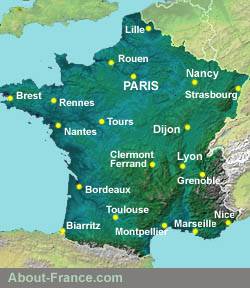
Check out the About-France.com
Online French Grammar
Free, full , clear explanations and lots of examples
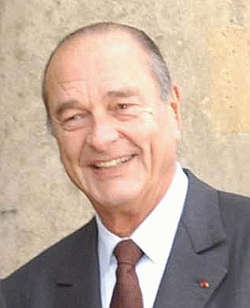
Jacques Chirac, former president of France
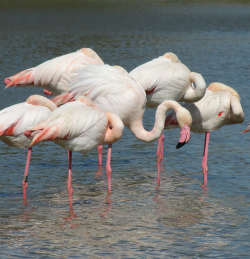
Flamingoes in the Camargue wetlands
Champagne picture by Alexsky.
Portrait of Jacques Chirac by W Dias, Agencia Brasil. Creative commons 3. licence